
If you are launching lean, the right first custom packaging order is smaller than most suppliers will tell you, and the right time to place it is later than most founders assume. Start with stock or minimally-branded packaging while you validate demand, move to a real custom run once you have a repeatable SKU and a launch date, and keep that first run close to your true minimum order quantity (50 units on most box styles at MetaSys) rather than buying down to a lower unit price you will not use for months. The rest of this guide walks through the sequencing, the budget math, and the supplier checks that keep a first-time order from becoming an expensive lesson.
Do you actually need custom packaging yet? A quick gut check
Custom packaging earns its cost when it does one of three jobs: it protects a product that stock boxes damage in transit, it drives repeat purchase or referral through an unboxing moment worth photographing, or it is the only way to fit a product's actual dimensions without excess void fill. If none of those apply yet, stock packaging with a simple printed label or sticker is the correct answer for now, not a compromise.
The honest test is whether you have sold the product yet. Pre-launch, with no confirmed demand, custom packaging is a bet on a number you cannot verify. Post-launch, once you have real orders and a settled SKU count, the math changes: you know your volume, your dimensions, and whether returns or damage claims are a problem. That is the point to move. If you are still iterating on the product itself, wait. A box designed around a spec that changes in six weeks is money spent twice.
If you are unsure which side of that line you are on, our guide to custom packaging costs for a small business walks through the cost drivers in more detail, and the small business packaging page is built specifically for founders at this stage.
How low can minimum order quantities really go, and what you give up to get there
Every supplier advertising "no minimum" or an extremely low MOQ is trading something for that number, usually one of three things: a higher per-unit price that makes the low quantity a rounding error on their end, a narrower set of box styles or finishes available at that quantity, or a longer lead time because your tiny order gets batched with other customers' runs on the same press sheet.
None of those trade-offs are automatically bad. A founder ordering 50 units to test a farmers-market launch does not need offset printing economics; digital printing at a slightly higher per-unit cost is the right tool for that job. The problem is suppliers who advertise "no minimum" without disclosing which of the three trade-offs applies, so you find out at the invoice or at the delivery date instead of at the quote.
At MetaSys, minimums start at 50 units on most box styles, including mailer boxes and standard product boxes. Some specialty formats, foil-heavy finishes, or unusual structural styles carry higher floors, typically 100, 200, or 500 units, because the setup work (dies, plates, press calibration) does not scale down cleanly below that point. A supplier quoting you 50 units on a die-cut rigid box with multiple foil colors is either absorbing a loss to win your business or cutting a corner you have not been told about. Ask directly which it is.
Right-sizing your first run: why more units isn't a better deal
Every packaging supplier's price sheet rewards volume, which makes it tempting to round up "while you're at it." Resist that instinct on a first order. The math that makes 500 units cheaper per unit than 100 only pays off if you actually use all 500 units before your design, your product spec, or your branding changes. For a startup in its first year, that assumption fails more often than it holds.
Here is the actual trade-off, not the sales pitch version:
| Order size | Per-unit cost | Cash tied up | Real risk on a first order |
|---|---|---|---|
| 50 units (minimum) | Highest per unit | Lowest | Fastest to reorder once you learn what's wrong |
| 100 to 250 units | Meaningfully lower | Moderate | Manageable if your SKU is stable |
| 500+ units | Lowest per unit | Highest | Design or spec changes strand inventory you already paid for |
The founders who get burned are not the ones who order too few units. They are the ones who order 1,000 units to chase a lower unit price, then change their logo, their box dimensions, or their product formulation four months later with 600 units still in a storage unit. A smaller first run costs more per box and far less in total risk. Order close to your minimum, sell through it, and let your second order reflect what you actually learned, not what you guessed.
Budget sequencing: what to make custom first, second, and later
Not every packaging touchpoint needs to be custom on day one. Sequencing your spend protects cash while still giving customers something worth noticing.
First: the outer box or mailer, printed with at least your logo. This is the highest-visibility surface and the one thing every customer sees before they open anything. If your budget for packaging on this launch is one line item, this is it. A kraft mailer box or a simple printed product box covers most early-stage product categories.
Second: a branded interior touch. Once the outer box is covered, the next dollar goes to a printed insert card, a branded sticker sealing the box, or a simple pattern on tissue paper. These cost a fraction of the outer box and are what customers photograph for social media.
Later: structural upgrades and premium finishes. Foil stamping, soft-touch coating, custom-shaped inserts, and fully rigid box construction are real upgrades, but they are volume-driven investments. They make more financial sense once you have order history to justify committing to a design for 500 or 1,000 units at a time.
As a rough planning number, founders launching a physical product typically budget somewhere in the low-to-mid single-digit percentage of per-unit landed cost toward packaging on a first run, weighted toward the outer box. That is a starting point for your own math, not a rule, since a $12 candle and a $180 skincare set carry very different packaging expectations from the customer.
Sample before you commit: what a pre-production sample should actually prove
A sample is not a formality. It is the cheapest insurance in the entire process, and skipping it is the single most common way first-time buyers overpay without realizing it.
Understand what kind of sample you are looking at, because the terms get used loosely:
- A stock or blank sample shows you the box structure and material with no print. Useful for confirming fit and rigidity, useless for confirming brand colors.
- A digital or 3D mockup is a rendering, not a physical object. Every quote from MetaSys includes a free 3D mockup so you can see color and layout before committing to a physical sample, but a mockup on screen is not the same as the material in your hand under real light.
- A pre-production physical sample is built from your actual approved dieline and artwork, in the real material and finish you have specified. This is the one that matters before a bulk order. It should prove four things: the printed color matches what you approved on screen, the box holds your actual product at the dimensions you specified, the finish (matte, soft-touch, foil) looks and feels the way you expected, and the structural fold and closure work without you having to force it.
The diagram below walks through where a sample sits in the process and what it is protecting you from.
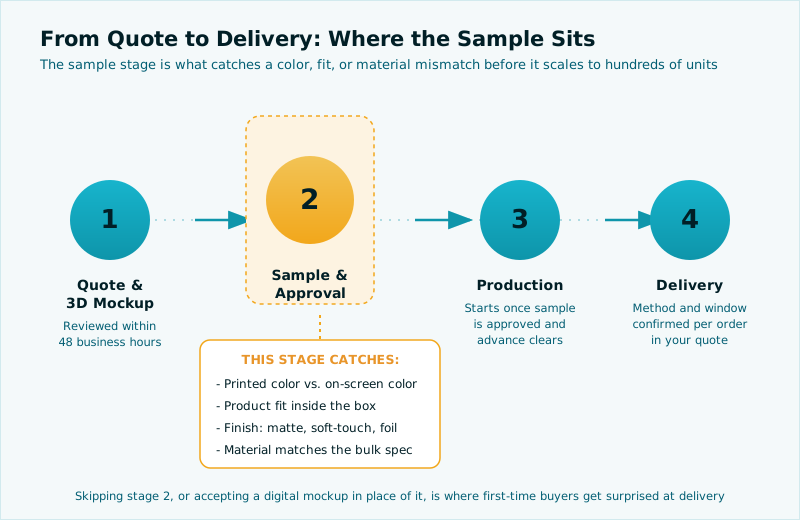
If a supplier pushes you straight from quote to full production with no sample step, or offers only a digital mockup and calls it sufficient, treat that as a warning sign, not a convenience. At MetaSys, the sample fee credits toward your first production order, so it functions as a research cost rather than a sunk one. Request a sample here before committing to volume.
Where first-time buyers overpay: reading a packaging quote line by line
A packaging quote with a single bottom-line number is not a complete quote. Before you accept one, make sure it itemizes:
Setup or tooling cost. Dies and plates are typically a one-time charge, separate from per-unit price. Confirm whether this is included in the quoted total or added on top, and whether it is waived or reduced on reorders using the same dieline.
Print method and color count. Digital printing versus offset changes both price and minimum order economics. If your design uses spot colors or foil, confirm each additional color or finish is priced as its own line, not bundled vaguely into "custom printing."
Material and structural spec, named specifically. "Kraft box" is not a spec. Board weight, flute type if corrugated, and coating should be named. This matters because the material quoted for your sample must be the material used in your bulk run. A quote that substitutes a lighter board or a different coating between sample and production without telling you is the most expensive mistake a first-time buyer can hit, because it surfaces after the units are already made.
Shipping and delivery timing. Delivery method and timeline should be confirmed per order in your quote rather than assumed, since routing depends on where your order is coming from and going to.
Payment terms. At MetaSys, standard terms are 50% advance to release the order to production, with the balance due Net 15 from invoice. Production does not start before the advance clears. If a supplier's terms are unclear or unusually front-loaded (100% upfront with no milestone tied to sample approval), ask why before you send a deposit.
Our breakdown of what actually drives custom packaging cost goes deeper on each of these line items if you want the full mechanics before your first quote call.
Supplier red flags to rule out before you send a deposit
A cash-constrained founder is the most exposed buyer in the entire packaging market, because an oversized order and a bad-faith supplier at the same time can do real damage to a launch budget. Rule out these signals before committing:
- No sample process, or a sample that skips your actual artwork. If a supplier cannot produce a pre-production sample from your real dieline and files, they cannot guarantee the bulk run will match it either.
- Vague material specs that only get named after you push. A legitimate supplier states board weight, coating, and print method up front, not only when asked twice.
- Full payment demanded before any sample or mockup review. Milestone-based payment tied to your approval at each stage is standard. A demand for full payment before you have seen anything physical is not.
- No clear answer on file and design ownership. Confirm in writing that your dieline, artwork files, and any custom tooling built for you are yours to reuse or take elsewhere on a reorder or a supplier switch.
- Reluctance to put quantity, price, and timeline in a single written quote. Verbal estimates that "firm up later" are how first-time buyers end up paying more than they expected at delivery.
- No independent point of contact for production questions. If every communication funnels through a single salesperson with no visibility into actual production status, delays are harder to catch early.
None of these are automatically disqualifying on their own, but two or more together on a first quote are reason to get a second quote before you commit.
A realistic timeline for a lean first packaging order
From an initial quote request to a finished order in hand, a first-time custom packaging run typically moves through four stages: quote and 3D mockup review (quotes are human-reviewed within 48 business hours of your request), sample production and your approval of that sample, the production run itself once the sample is approved and the deposit clears, and delivery, confirmed per order in your quote based on the actual routing for your shipment.
Rush timelines are sometimes possible depending on box style and current production load; our guide to lead times and rush orders covers what affects that timeline and how to plan around it if your launch date is fixed. The single biggest lever you control is submitting print-ready artwork and a locked product spec at the quote stage. Every round of "let me get back to you on the dimensions" adds real days to the calendar.
Common questions on a first packaging order
How many boxes should I order for my first custom packaging run? Order at or close to your supplier's minimum, typically 50 units for most standard box styles, rather than buying up for a lower unit price. A smaller first run costs more per unit but avoids stranding inventory if your design or spec changes before you reorder.
How much does custom packaging cost for a small business on a first order? Cost depends on box style, material, print complexity, and quantity, so there is no single number that applies across products. Request a quote with your actual dimensions and target quantity; MetaSys reviews every request within 48 business hours and includes a free 3D mockup so you can see cost and design together before committing.
Should I order a sample before committing to a bulk custom packaging order? Yes, always, and specifically a pre-production physical sample built from your approved dieline and artwork, not just a digital mockup. It is the only way to confirm printed color, fit, and finish match what you approved before hundreds of units are made.
Can I get custom packaging with no minimum order quantity? Genuinely minimum-free custom packaging is rare and usually means a materially higher per-unit price, a narrower set of available box styles, or a longer lead time folded into another customer's run. A clearly stated low minimum, such as 50 units, is a more reliable starting point than an unquantified "no minimum" claim.
Get a quote sized for where you actually are
Launching lean does not mean launching without a real plan for your packaging. It means matching the order to your actual stage: enough units to look professional and protect your product, not so many that a design change six months from now turns into a storage problem. Our custom packaging for small business page is built around this exact stage of a company, with the low-MOQ formats and sample process described above.
If you have a locked SKU and a launch date, request a quote with your product dimensions, target quantity, and timeline, and our team will come back within 48 business hours with pricing and a free 3D mockup. If you want to confirm fit and print quality before committing to a full run, start with a sample instead. Either way, you will have a real number to plan around instead of a guess.