Custom packaging cost is one of the first questions every brand asks and one of the hardest to answer without context. The honest answer: per-unit cost depends on five or six variables, and changing any one of them can shift your number by 30 to 200 percent. This guide walks through every cost driver, explains the quantity curve, shows you where the digital-to-offset crossover happens, and covers the most reliable ways to reduce spend without compromising your brand.
If you already have a product in mind and want a number specific to your spec, the fastest move is to request a quote. Our team reviews every submission and responds within 48 business hours.
The six cost drivers
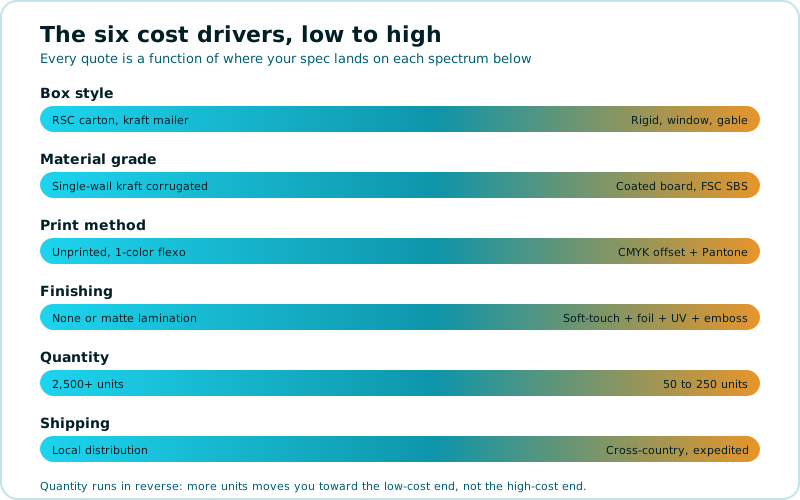
Before looking at any price range, you need to understand what is actually driving the cost. Every quote you receive is a function of these six variables.
| Cost Driver | Low-Cost Direction | High-Cost Direction |
|---|---|---|
| Box style | RSC shipping carton, kraft mailer | Rigid setup box, window box, gable box |
| Material grade | Single-wall corrugated kraft | Premium coated board, FSC-certified SBS |
| Print method | Unprinted or 1-color flexo | Full CMYK offset with Pantone spot colors |
| Finishing | None or matte lamination | Soft-touch + foil + spot UV + emboss |
| Quantity | 50 to 250 units | 50 to 250 units (per-unit cost is highest here) |
| Shipping | Local distribution | Cross-country freight, expedited lead time |
These six variables interact. A rigid box in a high-finish spec at 50 units is a materially different number than a kraft mailer at 1,000 units with one-color print. Treat the table above as a dial, not a menu.
Box style and what it costs to be in each tier
Box style is the single largest cost lever. Not all boxes are built the same way, and structure determines how much material, labor, and tooling go into each unit.
Tier 1 (lowest per-unit cost): Plain shipping cartons, standard mailer boxes in kraft, basic product boxes. Simple fold patterns, no special tooling, high-volume manufacturing compatibility. Our mailer boxes and shipping cartons fall here.
Tier 2 (mid-range): Printed mailer boxes with full CMYK exterior and interior, product boxes, display boxes, window boxes. More print surface area, die-cut tooling, and structural precision required.
Tier 3 (highest per-unit cost): Rigid boxes (setup boxes), luxury gift boxes, and anything requiring a lid-and-base construction or wrapped board. Rigid boxes are assembled by hand, not machine-folded, which increases both material use and labor significantly.
If budget is the primary constraint, box style selection is where you get the most leverage. A premium insert or a tissue paper wrap inside a Tier 1 box often delivers more perceived value per dollar than upgrading to Tier 3 construction. For a direct side-by-side within Tier 1, see how a mailer box compares to a shipping carton.
How material grade affects your cost
Material is the substrate your box is made from. The two main families are corrugated paperboard (for shipping and mailer structures) and folding carton board (for retail cartons and rigid boxes). Within each family, grade matters.
Standard kraft corrugated is the baseline. Coated or bleached grades cost more because the white surface accepts ink more precisely and delivers better color reproduction. FSC-certified and food-safe FDA-compliant materials carry a small premium for the certification supply chain, typically 5 to 15 percent over equivalent non-certified stock.
For a full breakdown of substrate options and what each one delivers, the packaging materials guide covers corrugated grades, folding carton board, kraft, and specialty stocks in detail.
Print method: the biggest quality and cost split
Print method is where most brands get surprised. The three methods used in custom packaging are digital, offset, and flexographic, and they serve different purposes.
Digital printing uses large-format inkjet or toner presses. No plates, no setup costs. You pay per unit. Small runs are economical. Color is excellent. Lead times are shorter. Best for small business packaging and test orders, including many Etsy and handmade sellers placing their first run.
Offset printing uses aluminum plates and runs ink through a series of rollers onto the substrate. High setup cost, low per-unit cost at volume. Color accuracy is outstanding. Pantone spot colors are achievable. Best for runs above 500 to 1,000 units depending on box size.
Flexographic printing applies ink through flexible rubber plates, primarily used on corrugated for shipping cartons and simple mailer boxes. Limited to 1 to 4 colors typically. Cost-effective at scale, limited in detail.
The crossover point from digital to offset varies by box size. For a standard ecommerce mailer box, the offset setup cost typically amortizes at around 500 to 750 units. Below that, digital wins on total cost. Above that, offset delivers meaningfully lower per-unit cost and better color consistency.
For everything you need to know about finish and print options, read the printing and finishing guide, or our printing methods explained post for the mechanics behind each press type.
Finishing: where per-unit cost accelerates fastest
Finishing is the set of surface treatments applied after printing. Each layer adds cost and adds perceived value. The challenge is that finishing layers compound on each other in cost.
Common finishes and their cost impact:
- Matte or gloss lamination adds modest cost, dramatically improves durability and color depth
- Soft-touch lamination adds a velvety texture, strong unboxing signal, meaningfully higher cost than standard lamination
- Spot UV applies a high-gloss coating to specific design elements only, adds cost per setup
- Foil stamping (gold, silver, copper, holographic) requires a die and a press pass, significant setup plus per-unit material cost
- Embossing or debossing requires a steel die, setup cost plus per-unit press time
You do not need all of these. Most high-performing ecommerce brands use one or two finishes rather than stacking all five. Soft-touch lamination plus a foil logo does more for perceived premium than a box with every finish competing for attention.
The per-unit cost curve: quantity matters most
No single factor changes your per-unit cost more than quantity. This is because most packaging cost includes a fixed component: tooling, plate setup, press setup, and structural dieline work. That fixed cost spreads across every unit you order.
Here is how the curve behaves qualitatively across a typical printed mailer box spec with full CMYK exterior:
| Quantity | Per-Unit Cost Tier | Notes |
|---|---|---|
| 50 units | Highest | Digital print only at this quantity; fixed costs undiluted |
| 250 units | High | Still digital territory for most specs; better unit economics than 50 |
| 500 units | Mid | Digital or offset crossover zone; setup cost starts to amortize |
| 1,000 units | Lower-mid | Offset viable and competitive; strong per-unit improvement |
| 5,000+ units | Lowest | Full offset economics; best per-unit cost; volume discounts apply |
The jump from 50 to 250 units is often significant. The jump from 1,000 to 5,000 is usually meaningful but not as dramatic. If you are ordering 50 units as a first test run, budget accordingly and plan your full production run at a higher quantity once you confirm the design.
For brands asking about the minimum viable order, the minimum order quantities guide covers what MOQs look like across different box types and why they exist.
Wholesale and high-volume pricing
At volume above 2,500 to 5,000 units, packaging enters a different pricing tier. Press capacity is used more efficiently, material procurement happens at scale, and logistics consolidation reduces per-unit freight cost.
Wholesale custom packaging pricing is structured differently from small run pricing. If you are moving into wholesale territory, mention it in your quote request. Our team prices high-volume orders separately from standard runs.
How to reduce your packaging cost without compromising the brand
There are proven ways to bring cost down without visibly downgrading your packaging. The full guide to reducing packaging costs covers this in detail, but the highest-leverage moves are:
Right-size the box. Oversized boxes waste material on every unit and add dimensional weight charges on every shipment. Measure your product accurately and spec the box to fit with 10 to 15 mm clearance on each side.
Simplify the finish stack. One strong finish beats four competing ones, and costs significantly less. Choose soft-touch or foil, not both.
Increase your order quantity. Even moving from 100 units to 250 units can improve per-unit economics enough to pay for itself in 2 to 3 orders.
Drop the inside print on low-AOV products. Inside printing adds 30 to 40 percent to per-unit cost. For lower-priced products, that cost is difficult to justify unless the unboxing moment directly drives repurchase or social sharing.
Consider a simpler box structure. If you are using a rigid box because it looks premium, test whether a mailer box with soft-touch lamination and a foil logo delivers a comparable brand impression at lower cost.
Common cost comparisons brands ask about
How much more does a rigid box cost than a mailer box at the same quantity? Rigid boxes sit in Tier 3 and mailer boxes sit in Tier 1, so the gap is meaningful at any quantity: hand assembly, wrapped board, and lid-and-base construction all add labor and material that a machine-folded mailer box never touches. See our rigid box versus mailer box comparison for the structural reasons why.
What does custom packaging cost for a small Etsy or handmade shop specifically? Most handmade shops start in Tier 1 or Tier 2 at 50 to 250 units on digital print, which lands at the higher end of the per-unit curve but keeps the upfront commitment small. Our Etsy sellers guide walks through the specific choices that keep a first order affordable.
How much does FBA-compliant custom packaging cost for Amazon sellers? FBA compliance is a spec requirement, not a separate pricing tier: it adds specific dieline, labeling, and poly-bag requirements on top of whichever box style and quantity you choose, so the same six cost drivers above still apply. Read the Amazon FBA packaging requirements guide before finalizing your spec.
Getting your actual number
The honest reality is that no blog post can give you your number. Box size, material grade, print spec, finish selection, quantity, and shipping destination all interact in ways that require human review to price accurately.
What we can tell you: quotes come back within 48 business hours, include a free 3D digital mockup of your box, and require no commitment. If you want to try before you commit, a sample request is the right first step. Sample fees credit toward your first production order.
We have been working with US brands since 2018, with US sales and support based in Missouri and production coordinated through our Manchester and Lahore teams, and we ship to all 50 states. Our team has seen almost every box spec and almost every budget constraint. Submit your spec and we will give you an honest, human-reviewed number with no obligation.