

Subscription box packaging solves a different problem than a one-time e-commerce shipment. The box does not just have to protect one order. It has to reproduce exactly, on a fixed monthly schedule, with the same dieline and color match every time, while the insert, tissue, and theme inside change from drop to drop. That recurring cadence, not the box itself, is what makes subscription packaging its own category. This guide covers picking the right format, controlling cost as you scale, protecting fragile contents without overpaying for oversized boxes, and planning your reorder lead time so a shipping delay never threatens a drop date. For a closer look at formats and the reorder workflow built for monthly brands, see our subscription box packaging page.
What Makes Subscription Box Packaging Different From a One-Time Shipping Box
A one-time e-commerce order has to work once. It gets designed, produced, shipped, and the project ends. A subscription box has to work every month for as long as the subscriber stays active, which turns the packaging decision into two decisions: what stays fixed across every drop, and what is allowed to change.
The dieline, box dimensions, flute or board weight, and exterior print and color reference should stay fixed. Reprinting or re-tooling that spec every month adds setup cost and risk of color drift. The insert card, tissue print, sticker seal, and sometimes an accent color are what should change: that is where the monthly personality of the box lives, and the cheapest part to update.
Brands that treat subscription packaging like a series of one-time orders pay setup cost every month and fight color drift between drops. Brands that separate the fixed spec from the variable creative elements get a box that feels fresh every month without re-speccing anything. Our complete guide to custom packaging covers box selection fundamentals if you are starting from zero; this guide picks up where the reorder cycle becomes the constraint.
Low-MOQ Options for New and Small Subscription Brands
A new subscription brand rarely knows its exact subscriber count before the first box ships. Committing to a large run before you have real reorder data is the fastest way to end up with excess inventory of a box you will redesign in three months.
The minimum order on most box styles is 50 units, though some structures, mailers with added tooling like windows or handles, or heavier-duty formats, require 100, 200, or occasionally 500. That range works for a brand launching with a few hundred subscribers and lets you validate the box before committing to a larger run.
If you are still deciding on structure and print, request a physical sample before placing a production order. A sample confirms dimensions, board weight, and print color in hand, which matters more for a recurring box you will look at every month. Our guide to minimum order quantities breaks down what drives MOQ by print method and box style; our pieces on custom packaging for startups and small business packaging cover launching lean without overcommitting.
Corrugated Mailer or Rigid Box: Choosing the Right Style for Recurring Shipments
Most subscription boxes ship in corrugated mailers, and for good reason. Mailer boxes ship flat, assemble fast for kitting, print well in full color inside and out, and hold up to standard parcel handling without adding much weight. For a monthly box in the 1 to 8 lb range, a mailer is almost always the right default.
Rigid boxes make sense in narrower cases: a premium tier, a high-unit-value product like jewelry, or a brand where unboxing weight and stiffness are part of the promise made at signup. Rigid construction costs more per unit and takes longer since assembly is manual, not machine-folded. On a recurring shipment that extra cost repeats every drop, so it needs to be justified by what the subscriber is actually paying for.
The table below compares the formats most subscription brands choose between.
| Format | Typical minimum | Reorder cost pattern | Best for |
|---|---|---|---|
| E-flute mailer box | 50 units | Lowest cost, most reorder-friendly | Most subscription boxes under 5 lbs |
| B-flute mailer box | 50 units | Slightly higher than E-flute | Multi-item boxes, heavier product mix |
| Kraft mailer box | 50 units | Comparable to standard corrugated | Eco or natural brand positioning |
| Rigid setup box | 50 units | Highest per-unit cost, manual assembly repeats every drop | Premium tiers, high-value or gift-forward boxes |
| Shipping carton | 25 units | Lowest cost, less print detail | Bulk or multi-item subscriptions, heavier loads |
Our rigid box vs. mailer box comparison goes deeper on the construction and cost differences if you are deciding between the two.
How Much Does Custom Subscription Box Packaging Actually Cost
MetaSys does not publish a flat per-unit price because cost depends on too many variables to reduce to one number: box style, print coverage (outside only versus inside and outside), finishing, and volume all move it independently. What is consistent across styles is the shape of the curve: per-unit cost is highest at your minimum order and drops as volume increases, since setup cost is fixed and spreads across more units as the run grows.
For budgeting, think in tiers. A budget-tier mailer with one or two spot colors outside only sits at the low end. A mid-range box with full CMYK and one printed interior wall sits in the middle. A premium box with full inside-and-outside print and a finish like soft-touch lamination or foil sits at the top, depending on how much of the unboxing moment, and your monthly cost per subscriber, you want to invest.
The reliable way to get a real number is to send your product dimensions, target volume, and reference brands to a supplier and get quantity breaks back. Reducing packaging costs covers additional levers, like right-sizing and material substitution, that apply just as directly here as to a one-time order.
Building an Unboxing Experience That Gets Shared: Inserts, Tissue, and the Reveal Sequence
The reveal sequence, what a subscriber sees in the first five seconds of opening the box, is the part of subscription packaging most likely to end up on camera. Three elements do most of the work, and none require reprinting the box itself.
Inside print. The interior is print space that ships free. A branded interior wall or lid means the subscriber sees your brand before the product. It is set once with the structural print run and reused every month; only the insert or outer artwork needs updating for a themed drop.
Branded tissue and wrap. Tissue does not protect the product, but it controls the pacing of the reveal and adds color and texture plain packing paper does not. Printed tissue in a rotating seasonal color is one of the cheapest ways to make a box feel new without touching the dieline.
The insert card. This is the highest-leverage piece because it is built to change every drop. A product spotlight, a subscriber note, a QR code to reorder, or a thank-you card each do a different job, and all can carry a new design every month without touching the box itself.
The diagram below shows how that split works in practice: what stays fixed on the structural spec, and what gets refreshed on the reorder cycle.
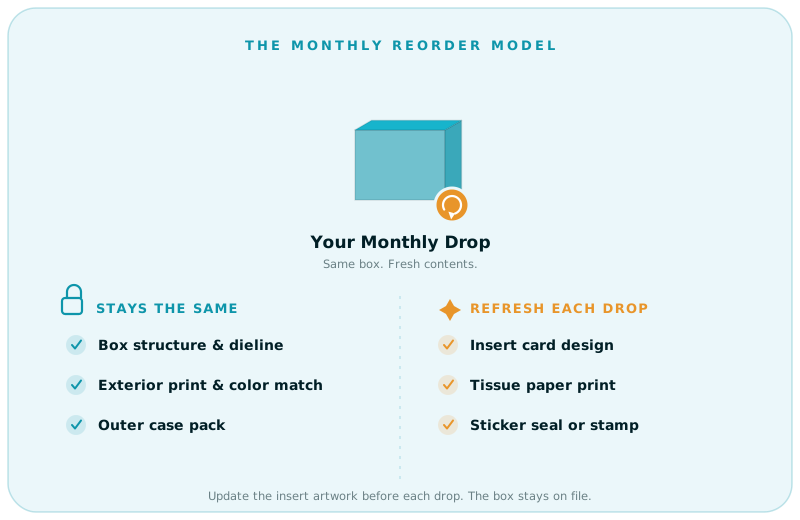
Keeping this split clear from the start is what lets a subscription brand run a new theme every month without a new production setup every month. See print and finishing options for the full range of interior print, foil, and coating choices available on a mailer box.
Protecting Contents in Transit Without Paying for Oversized Packaging Every Month
An oversized box does two things wrong at once: it lets contents shift in transit, and it wastes dimensional-weight shipping cost on every shipment. For a one-time order that waste happens once. For a box shipping to thousands of subscribers every month, it compounds on every drop, indefinitely.
The fix is sizing the box to the actual product mix rather than the largest item you might ever include. If monthly contents vary in volume, a divider or insert built for your smallest reliable configuration, with simple filler for lighter months, controls both damage and shipping cost better than a box sized for the biggest possible month.
For fragile items, a die-cut insert or molded pulp tray beats loose fill for a recurring box because it reorders identically every month, unlike loose fill that varies by hand-packing. Packaging for fragile products covers insert and cushioning options in more depth.
Planning Reorders Around Your Pack Date: Lead Time and Safety Stock
A subscription box has a hard deadline every month: the pack date. Miss it and the drop slips for every subscriber at once, not just one order. That makes reorder planning a bigger operational risk than shipping on demand.
Start with the quote itself. Every quote request gets a human response within 48 business hours, including your production timeline for that specific order, so you know your real lead time before you commit rather than guessing from a generic estimate. Production and shipping time vary by box style, print method, and volume, and your actual dates get confirmed per order rather than published as one flat number that may not apply to your run.
Build a safety stock buffer into your reorder schedule rather than ordering exactly what you need for the next drop. A buffer of one extra pack cycle protects against a delayed proof approval or a shipping delay without forcing a rush order, which tends to cost more and compress your quality checks. If your window is genuinely tight, our guide on lead times and rush orders covers how rush production works and what it costs.
One more detail for your cash flow: production orders release against a 50 percent advance, with the balance due Net 15 from invoice. Plan that advance into your reorder calendar the same way you plan your pack date, especially on a monthly cadence.
Designing Packaging That Scales as Your Subscriber Count Grows
The box that works at 200 subscribers is not always the box that works at 5,000. Volume changes what is economical, and product mix changes what fits. Planning for that shift early avoids a full redesign later.
Moving from a small mailer run to a much larger one changes which print method makes sense. A brand that starts on digital print because it fits a smaller drop often moves to offset once volume justifies the plate setup, since offset drops per-unit cost more sharply at scale. That does not require a new box design, only a new production method against the same spec.
On the format side, a box that starts as a single small item can outgrow a mailer as the curated mix grows to multiple items or heavier products. At that point, a larger mailer, a multi-item box with dividers, or in some cases a shipping carton protects the economics better than forcing more product into a box sized for one item. Our mailer box vs. shipping carton comparison walks through when that switch makes sense.
At the volumes that come with real subscriber growth, our wholesale custom boxes page and wholesale custom packaging guide cover how bulk purchasing and case-pack planning change at that scale.
Sustainable and Recyclable Packaging Options That Fit a Monthly Reorder Cycle
Subscription boxes generate packaging waste on a recurring basis in a way a one-time purchase does not, and subscribers notice. The sustainability choices that matter most are the ones that do not require a new decision every month.
FSC-certified kraft or recycled-content corrugated is a one-time material selection that applies to every future reorder without adding a step to production. The same goes for soy-based inks and avoiding plastic windows or laminate coatings that make a box harder to recycle curbside. Each is a decision made once, on your first order, and it carries forward automatically because it is part of the saved structural spec.
Where sustainability does compete with reorder cadence is on finishing. Foil stamping and certain laminates add cost and are harder to recycle; a soft-touch coating on FSC-certified board is a middle path that keeps most of the premium feel without the trade-off. Our eco-friendly packaging materials guide covers sustainable substrates and finishes, and our sustainability page details FSC and recycled-content options in full.
What to Have Ready Before You Request a Subscription Box Packaging Quote
A subscription box quote moves faster when a supplier has the reorder context up front, not just box dimensions. Before you request a quote, have these ready:
- Product dimensions and weight, including your heaviest realistic monthly configuration
- Current or projected monthly subscriber volume
- Your pack date and how far in advance you need boxes on hand
- Whether inside print, tissue, and inserts are print-ready or still in design
- Three to five reference brands your unboxing should feel similar to
- Any sustainability commitments (FSC, recycled content, no plastic) for material selection
Sending this up front means a quote response answers the question you actually have, what this box costs at your volume and cadence, instead of a generic range.
A few questions we hear most from subscription brands before their first order:
How much does custom subscription box packaging cost per unit? It depends primarily on box style, how much of the box is printed (outside only versus inside and outside), added finishing, and order volume, with cost dropping as volume increases. We do not publish a flat number since those variables move price too much; send your specs and we return quantity breaks in your quote.
What size box should I use for a subscription box? Size it to your smallest reliable monthly configuration plus dividers or filler for a slightly larger month, rather than sizing for the biggest possible month. An oversized box raises both damage risk and dimensional-weight shipping cost on every drop.
Should I use a mailer box or a rigid box for a recurring subscription shipment? A mailer is the right default for most subscription boxes: it costs less per unit, carries a lower minimum, and reorders faster. A rigid box earns its added cost only on a premium tier where the box's weight and stiffness are part of what the subscriber signed up for.
How far in advance should I reorder subscription box packaging each month? Confirm your exact production and shipping timeline in your quote, since it varies by box style and volume, then build in one extra pack cycle of safety stock so a delayed proof or shipping delay never threatens a drop date.
Get a Quote Built Around Your Reorder Cycle
A subscription box is a production relationship, not a single order. Send us your product dimensions, current or projected volume, and reference brands, and we will spec the right format, printing, and finishing for your first drop, plus outline how the reorder workflow runs after that. Every quote includes a free 3D mockup and a response within 48 business hours.
Request your quote to get started, or if you want to hold a box in your hands before committing to a production run, request a physical sample first. For the full breakdown of formats and the reorder workflow built specifically for monthly brands, revisit our subscription box packaging page.


