
Wholesale custom packaging gets cheaper per unit as volume rises because the fixed costs in every order (plates, dies, press setup) get divided across more boxes, not because the material itself costs less at scale. Understand that one mechanism and every other question in bulk buying, from MOQ to reseller markups to how many boxes to order, gets easier to answer. This guide covers the real cost structure, who should buy where, and how to avoid the two most common bulk-buying mistakes: over-ordering inventory you can't move, and paying a trading company's markup without knowing it.
If you're evaluating suppliers right now, our wholesale custom boxes page covers volume pricing and account setup directly. This article is the buying education underneath that decision.
How Wholesale Custom Packaging Pricing Actually Works
Every custom box quote has two cost components: a fixed cost that doesn't change with quantity, and a variable cost that scales with it.
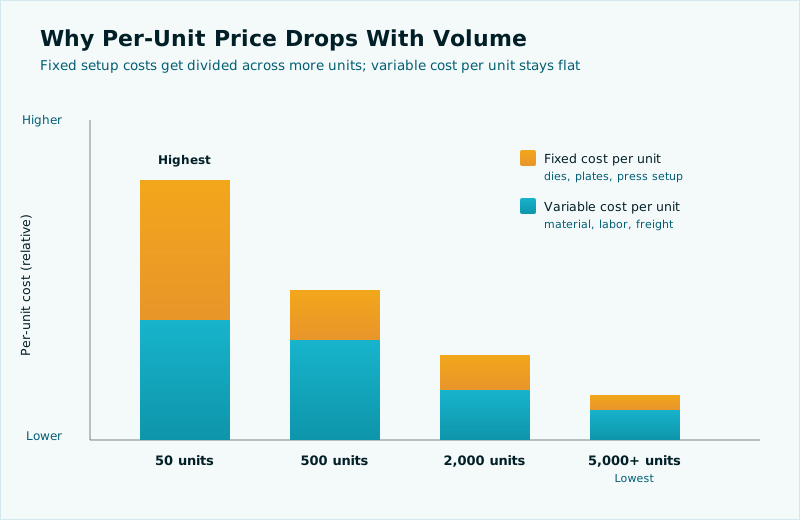
The fixed cost covers things that happen once per order regardless of whether you're buying 100 boxes or 10,000: engraving a printing plate, cutting a steel die, calibrating a press, running a first-article inspection. A die doesn't cost less to cut for a small order, and a press doesn't take less time to color-match. That cost gets divided across your total unit count, so at low quantities it dominates the per-unit price, and at high quantities it becomes a rounding error.
The variable cost is what most buyers expect a quote to be: substrate, ink, coating, assembly labor, and freight, multiplied by units ordered. This part scales close to linearly. It's the fixed side that creates the steep discount curve everyone associates with "buying in bulk."
Once you separate the two, the rest of wholesale buying is just math: how many units before the fixed cost per unit becomes small enough to stop mattering.
The Per-Unit Cost Curve: Why Price Drops as Volume Rises
The curve isn't a straight line. It drops fastest in the earliest quantity jumps and flattens out at higher volumes, because the fixed-cost share shrinks fastest early and has less and less left to shrink later.
| Order Size | Who Typically Buys Here | What Drives the Price |
|---|---|---|
| 50 to 250 units | New brands, first production run, single-SKU launches | Fixed cost (plates, die, setup) dominates the per-unit price |
| 250 to 1,000 units | Growing brands with sales history, second or third reorder | Fixed cost share drops fast; material and labor start to matter more |
| 1,000 to 5,000 units | Established SKUs, seasonal stock-ups, subscription programs | Fixed cost is now a minor line item; press efficiency and material sourcing drive price |
| 5,000+ units | Multi-location retailers, distributors, high-volume resellers | Diminishing returns; savings come from freight consolidation and material contracts, not setup amortization |
The steepest part of the curve sits in the first two rows. That's why a brand moving from a 100-unit test run to a 500-unit reorder usually sees a bigger jump in value than one moving from 5,000 to 10,000. Past a certain point you're not buying down fixed cost anymore, you're negotiating raw material and freight, a different conversation with your supplier.
Setup, Tooling, and Die Charges: The Fixed Costs Behind Every Quote
Three line items make up nearly all the fixed cost in a custom packaging quote, and understanding them is the single most useful thing a bulk buyer can learn.
Die charges. A custom box shape (not a stock template) requires a steel rule die cut to your exact dimensions, typically a one-time charge. The die is retained by the supplier for reorders, so a repeat run of the same style and size shouldn't carry it again. Confirm in writing whether a quote charges for a new die or reuses one on file.
Printing plates. Offset and flexographic printing require a plate or cylinder per color, so a four-color design needs four plates, usually a one-time charge tied to a specific artwork file. Change the artwork and new plates are typically required.
Press and line setup. Calibrating a press for your color profile and setting up assembly or gluing lines takes real labor time regardless of run length, sometimes itemized separately, sometimes folded into the per-unit rate.
Ask your supplier to break these three items out separately, and whether each is one-time or recurring. A supplier who won't itemize tooling apart from per-unit cost makes quotes hard to compare apples-to-apples, worth treating as a caution flag on its own.
What Minimum Order Quantities Really Mean (and When They're Negotiable)
A minimum order quantity exists because, below a certain volume, the fixed cost per unit becomes so high the order stops being economical for either side. Our full breakdown in minimum order quantities explained covers this style by style; the short version is that MOQs are a floor set by tooling and material minimums, not an arbitrary policy number.
MOQs are more negotiable than most buyers assume, but the leverage runs in a specific direction. A supplier is more likely to flex if you offer something that offsets their fixed cost: a stock box size instead of a custom die, a simpler one- or two-color print instead of full CMYK, or a documented commitment to a follow-on order. What rarely moves the number is just asking; come with a workable trade, not just a lower target.
Most MetaSys box styles carry a minimum of 50 units; a few structurally complex styles require 100, 200, or 500 depending on tooling and assembly demands. If your volume sits right at a boundary, it's worth a direct conversation before you assume the number is fixed.
Reseller or Trading Company vs. Direct Manufacturer: Who Should Buy Where
This is the distinction that gets the least honest treatment in most packaging content, because a lot of that content is written by resellers themselves.
A trading company or reseller doesn't run production. It places your order with a factory it has a relationship with and adds a markup for sourcing and oversight. That markup isn't inherently dishonest, but it's a cost layer most buyers never see, baked into the unit price rather than disclosed.
A direct manufacturer relationship removes that layer. You're quoting and reordering with the party actually producing your boxes, which usually means fewer handoffs, faster answers, and pricing that reflects production cost plus one margin instead of two.
| Factor | Trading Company / Reseller | Direct Manufacturer |
|---|---|---|
| Pricing structure | Factory cost plus reseller markup, usually undisclosed | Production cost plus one margin |
| Communication | Routed through a middleman; spec questions take longer | Direct with the team producing your order |
| Production accountability | Reseller isn't the one fixing a QC issue | Direct line to the party responsible for the run |
| Tooling ownership | Sometimes unclear who retains the die | Die and plates retained by the producer for reorders |
| Best for | One-off small orders where sourcing effort outweighs the markup | Repeat bulk buyers who value pricing transparency and direct answers |
Neither model is wrong for every buyer; a single small trial order can genuinely be easier through a reseller with existing factory relationships. But once you're buying at wholesale volume repeatedly, that markup compounds on every reorder, which is exactly the range where going direct pays off most.
Brand Owners vs. Resellers: Two Different Buying Strategies
"Wholesale buyer" isn't one persona, and the two most common versions of it should buy differently.
A brand owner is usually buying one or a handful of SKUs, with direct financial exposure if the run doesn't sell. Their leverage is depth: a large, focused order on one design gives a supplier a clean, high-volume run and usually the best per-unit pricing available. Brand owners should get one SKU exactly right before scaling quantity, since a packaging mistake at 5,000 units is a much bigger problem than one at 250.
A reseller or distributor is usually buying across many SKUs, with a warehouse model that spreads risk across the portfolio. Their leverage is breadth and repeat volume: a relationship spanning multiple product lines often earns better terms than any single order would justify alone. Resellers should optimize for supplier reliability and consistent reorder turnaround over squeezing the last percentage point out of one run.
If you're a brand owner deciding how big your first run should be, our guide on what custom packaging actually costs covers the budgeting side in more detail.
Domestic vs. Overseas Bulk Sourcing: Lead Time, Landed Cost, and Risk
Buyers evaluating wholesale sourcing usually frame this as a simple cost question, and it isn't one. Unit cost, total lead time, and risk exposure if something goes wrong mid-production move together and need weighing as a set.
A shorter, simpler supply chain generally means faster answers and fewer parties between you and a production fix. A supply chain built for scale generally means more competitive per-unit pricing at real wholesale volume, because the infrastructure is built for exactly that range. Neither side is automatically right; it depends how much your business can absorb in lead time versus unit cost.
What matters most isn't which model a supplier uses, it's whether they're straight with you about the schedule. A blanket "ships in a week" promise on a large custom bulk order almost never survives contact with an actual production queue. MetaSys confirms production and delivery windows per order, once your box specs, print complexity, and quantity are locked, rather than quoting a fixed transit number up front. Our lead times and rush orders breakdown covers what actually moves that schedule.
How Much to Actually Order: Avoiding the Overstock Trap
The volume discount curve creates a real temptation to round up. It's worth resisting without a specific reason to override it, because the cost of unsold inventory rarely shows up in the same conversation as the per-unit savings that justified buying it.
A useful way to size your first bulk order: take your realistic sales velocity for the next two to three inventory cycles, not your optimistic one, and order to cover that window plus a modest buffer. If a 1,000-unit order clears your cost-curve sweet spot but your honest forecast only supports 400 units, the "savings" on the other 600 are theoretical until they sell, and very real once you count warehousing and cash tied up in boxes instead of product.
Three guardrails help: start with a physical sample before any bulk order, since it's far cheaper to catch a sizing issue on one sample than a 2,000-unit run; match reorder cadence to actual sell-through rather than a calendar, ordering smaller and sooner until you have real data; and price out the full cost of a surplus, not just its storage fee. Capital tied up in unsold boxes is capital that isn't available for the product going inside them.
Red Flags in a Wholesale Packaging Quote
A handful of patterns are worth slowing down over before you commit:
- Tooling and setup costs bundled into the per-unit rate with no breakdown. You can't tell if you're paying for a new die or a reused one, and you can't compare quotes line by line.
- A fixed, aggressive turnaround promise with no mention of production stage or quality checks. Real bulk production has real steps; skipping over them isn't necessarily dishonest, but it's less information than you need.
- No mention of who retains the die or plates for your reorder. If that isn't specified, ask directly, since it affects pricing on every future order of the same design.
- Payment terms that don't match how production actually works. Custom production shouldn't start before a deposit clears. MetaSys structures this as 50% advance to release the order to production, balance due Net 15 from invoice, and doesn't start production before the advance is confirmed, for new and established accounts alike.
- Pricing that barely moves between quantity tiers. If a price at 500 units and 2,000 units looks nearly identical, the setup cost either wasn't disclosed, or the tiering isn't being explained clearly.
A Realistic Bulk Ordering Timeline, From Quote to Delivery
A wholesale custom packaging order moves through the same core stages regardless of supplier: quote and spec confirmation, a sample or 3D mockup approval, a production deposit, the production run with quality checks, then freight and final delivery. Every MetaSys quote includes a free 3D mockup at the spec-confirmation stage and comes back within 48 business hours of a human reviewing your specs, not an automated estimate.
Where buyers get surprised isn't usually any single stage, it's assuming the whole sequence compresses into "a week or two" because that's what a smaller, off-the-shelf order might take. A genuinely custom bulk run has real production and quality-check time built in before freight even starts. Confirm your specific timeline as part of your quote instead of assuming a generic number applies.
Quick Answers for Bulk Buyers
How much do custom boxes cost when ordered in bulk? Cost isn't a single number, it's a curve: the per-unit price drops sharply as fixed costs like dies, plates, and press setup get divided across more units, then flattens once those fixed costs become a small share of the total. The steepest savings happen in the earliest volume jumps, not at the top of the range.
Is it actually cheaper to buy packaging in bulk, or does storage cost eat the savings? Depends on your real sell-through. Per-unit price is genuinely lower at higher quantities, but if you order more than your forecast supports over the next two to three inventory cycles, the cost of storing and financing the surplus can offset or exceed the discount you were chasing.
Should I buy from a reseller or go direct to the manufacturer? For a single small trial order, a reseller's existing factory relationships can save sourcing time. For repeat wholesale volume, going direct removes a markup layer that compounds on every reorder, which usually makes direct the better economics at scale.
Can I negotiate a lower MOQ with a packaging manufacturer? Sometimes, and it moves further with a trade than a request alone. A stock box size instead of a custom die, simpler print colors, or a committed follow-on order gives a supplier something to offset their fixed cost against; asking for a lower number with no offset rarely works.
Get a Wholesale Quote Built Around Your Actual Volume
The fastest way to see where your order lands on the cost curve is to send us your box dimensions, target quantity, and print complexity. Every quote includes a free 3D mockup and a response within 48 business hours, broken out so you see tooling, setup, and per-unit cost as separate line items instead of one bundled number. Still narrowing down size or material before committing to a bulk quantity? Request a physical sample first. Otherwise, visit our wholesale custom boxes page for volume pricing details or get your wholesale quote started here and we'll show you exactly where your volume sits on the curve.