Every brand that sources custom packaging hits the same wall early: the supplier has a minimum order quantity and your launch plan does not. Understanding why MOQs exist, how they vary by box style and print method, and how to work around them intelligently will save you from over-ordering inventory you cannot move or under-ordering packaging that sells out in three weeks.
This is a practical breakdown of how minimums work, what drives them, and what your options are when you are launching lean.
Why minimums exist in the first place
Custom packaging is not printed on demand the way a home inkjet prints a document. Every order involves physical setup that happens before the first box is produced.
Printing plates and cylinders. Offset and flexographic printing require engraved or imaged plates for each color in the design. A four-color offset job requires four plates. Each plate carries a real cost that scales with its size and the resolution of the design. That setup cost does not shrink when your order is small. It amortizes across the run. At 100 units, the plate cost per box is high enough to make offset printing economically unreasonable.
Material minimums from mills. Paperboard and corrugated are sold in rolls and sheets with mill minimums that often require 500 or more square meters of substrate per order. When a supplier orders custom material for your job, they cannot order a half roll.
Die cutting and tooling. A custom box size requires a custom die, which is a steel cutting form that punches out the exact shape from flat sheet. Die fabrication carries its own tooling cost, and that cost, like plates, amortizes across the run.
Labor setup time. Press setups, color calibration, and first article inspections take 1 to 4 hours regardless of run length. That setup time is the same for 50 boxes as it is for 5,000.
The result: a 50-unit run and a 500-unit run may have nearly identical fixed costs. The per-unit cost at 50 units is often 4 to 8 times higher than at 500 units simply because fixed costs do not scale.
How minimums differ by box style
Not every box type carries the same minimum. Structural complexity and the machinery required to produce each style set the floor.
| Box Style | Typical Minimum | Best Print Method | Notes |
|---|---|---|---|
| Mailer boxes | 50 units | Digital or offset | E-flute corrugated; digital works well at low quantities |
| Rigid setup boxes | 50 units | Offset | Assembly labor is manual; setup cost spread over fewer units |
| Product/folding cartons | 100 to 250 units | Digital (short run), offset (250+) | Smaller footprint per box makes lower minimums viable |
| Shipping cartons | 25 units | Flexographic or digital | Standard sizes reduce tooling cost |
| Display boxes | 100 units | Offset | Structural complexity raises minimum |
| Window boxes | 100 units | Offset | Window die and lamination film add setup |
| Gable boxes | 100 units | Digital or offset | Handle tooling adds cost at low quantities |
| Kraft boxes | 50 units | Digital or 1 to 2 color flexo | Natural substrate reduces bleaching cost |
The minimums above reflect standard custom sizes. If you choose a size that matches a stock die template, minimums sometimes drop by 25 to 50 percent because tooling cost is already amortized.
How print method shifts your minimum
Print method is the largest single variable in how low your order floor can go. Read our full printing and finishing guide for a deeper technical breakdown. Here is the summary by method.
Digital printing
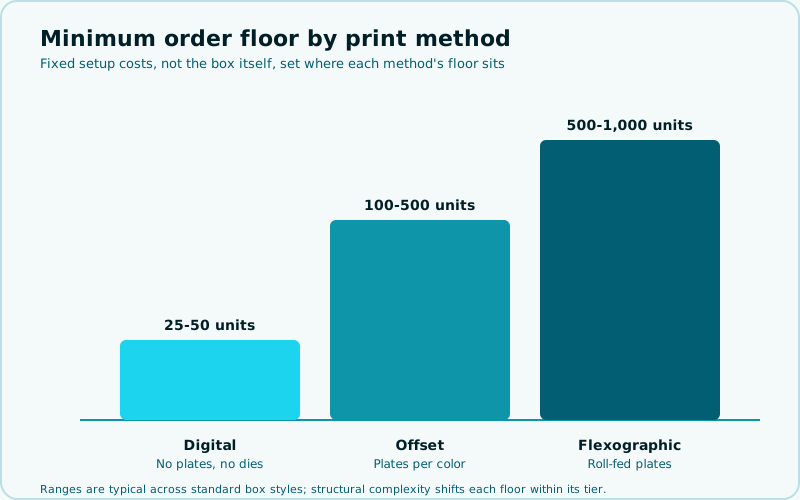
No plates. No dies beyond structural cutting. The press receives a digital file and prints directly to substrate.
- Minimum: as low as 25 to 50 units on most styles
- Setup cost: minimal, often waived entirely depending on supplier
- Per-unit cost: flat across the run, does not drop sharply with volume
- Color accuracy: commercial standard (Delta E 3 to 5)
- Best for: launch runs, product testing, seasonal variants, high-SKU catalogs
Digital is the right choice when you are not yet confident in a size or design. It lets you test packaging in market before locking into a larger offset run.
Offset printing
Plate-based. Full-color CMYK plus Pantone spot colors. Highest color accuracy (Delta E under 2).
- Minimum: 250 to 500 units for most folding cartons; 100 to 250 units for corrugated styles
- Setup cost: the highest of the three methods, driven mainly by plate count on a typical 4-color job
- Per-unit cost: drops significantly at 500 units, again at 1,000, again at 5,000
- Color accuracy: near-exact Pantone matching
- Best for: established SKUs with predictable demand, Pantone-critical brand colors
Offset becomes the economical choice once your volume is large enough that setup cost is less than 10 to 15 percent of total order value.
Flexographic printing
Roll-fed. One to four spot colors. Best on corrugated and kraft substrates.
- Minimum: 500 to 1,000 units
- Setup cost: charged per color, though it amortizes fastest at the volumes flexo is built for
- Per-unit cost: lowest of all methods at high volume
- Color accuracy: spot color only; full CMYK photo quality is not achievable
- Best for: shipping cartons, mailer boxes in one or two brand colors, very high volume runs
Flexo is the method of choice when you are running 2,000+ units of a corrugated style and brand identity is captured in one or two solid colors.
The per-unit cost curve
The relationship between quantity and per-unit cost is not linear. It drops steeply in the early ranges and then flattens. For the full mechanics of what drives that price beyond just quantity, our complete pricing guide covers all six cost drivers.
| Quantity | Per-Unit Cost Tier | Why it drops |
|---|---|---|
| 50 units | Highest | Setup cost at maximum per-unit impact |
| 100 units | High | Setup cost halved per unit |
| 250 units | Mid-high | Setup cost now a minor share |
| 500 units | Mid | Offset becomes viable; material cost dominates |
| 1,000 units | Lower-mid | Volume discount on material |
| 2,500 units | Low | Press run efficiency increases |
| 5,000+ units | Lowest | Material and labor at full efficiency |
These tiers apply to standard mailer and folding carton styles with two to four color printing. Rigid boxes sit at the higher end of every tier because of assembly labor. Shipping cartons with one-color flexo sit at the lower end.
The implication: the jump from 50 to 250 units typically cuts your per-unit cost in half. The jump from 250 to 2,500 units cuts it roughly in half again. Beyond 5,000 units, the savings are real but not dramatic.
How to launch lean without paying full per-unit penalty
A new brand, including many Etsy and handmade sellers, does not need to choose between over-buying inventory and paying peak per-unit prices. A few approaches let you go to market efficiently.
Start with a physical sample. Before ordering even 50 units, request a physical sample. A production-accurate sample confirms dimensions, material feel, and print color before you commit to a run. The sample fee credits toward your first production order.
Choose digital print for your first run. Accept the higher per-unit cost at 50 to 100 units as market research spend. You are buying information about how your packaging performs in customer hands, not buying packaging at maximum efficiency.
Standardize your box size. If your product dimensions can tolerate two or three standard size options, choose the one that matches an existing die template. This eliminates tooling cost and reduces your effective minimum.
Phase your order around your sales cycle. A single 250-unit offset run beats five separate 50-unit digital runs at the same total volume, once you account for per-unit cost, procurement time, and five rounds of setup, if you can forecast 250 units of sales within your inventory cycle. Run the numbers both ways before defaulting to low quantity.
Consider e-commerce packaging consolidation. If you sell multiple SKUs, packaging that works across product sizes reduces the number of distinct box runs you need.
When a higher MOQ is the right call
There is a temptation to always minimize upfront commitment. That instinct is often right for launches, but it costs money at scale. Once you have two to three inventory cycles of sales data and a stable product-market fit, the math almost always favors moving to a larger offset run.
At 1,000 units of a mailer box, the per-unit cost at offset sits near the bottom of the cost curve. Five runs of 200 digital-printed units land meaningfully higher per unit, and that comparison does not even count five separate setup events. The offset run not only costs less per box, it also costs less in procurement time, shipping overhead, and storage fragmentation.
For brands in health and wellness, beauty and cosmetics, or any category where packaging is part of the premium positioning, a larger offset run also enables finishing options like soft-touch lamination, foil stamping, and spot UV that are not available on digital presses. Those finishes are worth a per-unit premium at retail.
Common questions about MOQs
What is the minimum order quantity for custom packaging aimed at Etsy or handmade sellers specifically? The same floor applies as any other small brand: most box styles start at 50 units, and digital printing keeps that number reachable without a plate or die cost penalty. Etsy and handmade sellers most often start with a 50 to 100 unit digital run in kraft or a mailer box, then move to offset once a listing proves it sells.
How much does a 250-unit or 500-unit custom box order actually cost in dollars? It depends on box style, material, print method, and finish, the same variables covered earlier in this guide. Both quantities sit past the steepest part of the cost curve, so the per-unit number is meaningfully better than a 50-unit run. Send us your exact spec and we will price it precisely rather than in ranges.
What print method minimum applies if I need Pantone-matched colors on a short run? Pantone spot-color matching requires offset plates, so the minimum jumps to offset's floor, roughly 100 to 250 units on corrugated styles and 250 to 500 units on folding cartons, even if that feels like a large commitment for a first order. Digital presses can approximate a Pantone color through a CMYK build, but cannot hit an exact spot-color match. See our printing methods guide for how the two compare.
Next steps
The right order quantity is the one that matches your sales velocity, your cash position, and your confidence in the SKU. If you are launching, start with a sample and a digital run. If you are scaling a proven SKU, move to offset.
Send us your product dimensions, your current quantity thinking, and your design concept and we will send back a quote across two or three quantity breaks so you can see exactly where the cost curve lands for your specific box. Request your quote here and we will respond within 48 hours with pricing and a free 3D mockup.