Most packaging delays happen not at the press, but in the weeks before printing even starts. A brand manager who understands the full production pipeline can plan a product launch with confidence. One who does not will be scrambling for air freight two weeks before launch day.
This article breaks the timeline into every stage you will actually encounter, gives you realistic ranges for each, and shows you where delays pile up and how to prevent them.
The Full Timeline at a Glance
Here is a realistic range for the production-side stages of a common custom box order:
| Stage | Typical Duration |
|---|---|
| Quote + 3D mockup | 1 to 2 business days |
| Artwork and dieline approval | 3 to 10 business days |
| Physical sampling (optional) | 7 to 14 business days |
| Printing and finishing | 7 to 14 business days |
| Die-cutting and assembly | 2 to 5 business days |
| Freight (sea vs. air) | Confirmed per order in your quote |
| Production total (no sample) | 13 to 31 business days |
| Production total (with sample) | 20 to 45 business days |
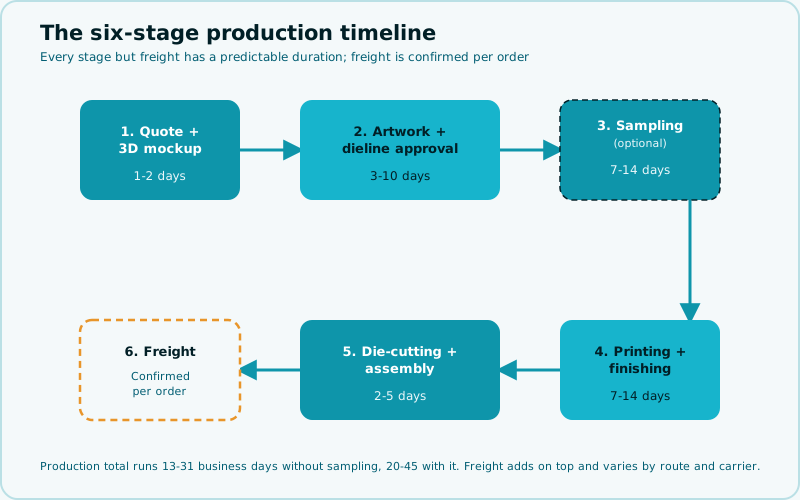
Freight sits on top of the production total above. Because the route, carrier, and consolidation schedule vary order to order, we do not publish a blanket transit time here. Rush production can compress the production side of this range; freight method and delivery window are confirmed as part of your quote once your run is scheduled.
Stage 1: Quote and Free 3D Mockup (1 to 2 Business Days)
Every order starts here. Submit your box style, dimensions, quantity, material, and finish requirements via our quote form, and you will have a response within 48 business hours.
We include a free 3D mockup with every quote so you can see the structure before committing to artwork. This is not a rendering based on stock photos. It is your actual box dimensions, rendered in 3D, which helps you spot proportion issues before your designer opens Illustrator.
Before you fill out a quote, measure your product correctly. If you are unsure how to size a box, the how-to-measure guide walks you through it step by step. Getting the dimensions right at this stage prevents a costly dieline revision later.
What slows this stage: Incomplete information. Missing dimensions, vague finish requirements, or uncertainty about quantity add back-and-forth before a quote can be finalized. Come prepared.
Stage 2: Artwork and Dieline Approval (3 to 10 Business Days)
This is where most timelines extend, and it is almost always driven by artwork readiness, not production capacity.
Once your quote is approved, you receive a structural dieline file. Your designer places artwork onto that dieline and submits a print-ready file. Our prepress team reviews it for color mode (CMYK, not RGB), bleed, resolution (minimum 300 dpi at final size), and font embedding.
Common issues that trigger revision rounds:
- RGB artwork submitted instead of CMYK. Colors shift on press. The conversion must happen before approval, not after.
- Low-resolution logos or photos. A 72 dpi logo pulled from a website will print soft. This is not fixable in prepress without the original file.
- Bleed not extended to dieline edges. Any gap between artwork and the cut line shows as a white stripe on the finished box.
- Special finish zones not specified. If you are adding spot UV or foil, those areas need to be called out on a separate layer. A file missing this information goes back to the designer.
If your brand has a well-organized asset library and a designer who has worked with print files before, approval can happen in three to four business days. If the artwork is being created from scratch or needs multiple rounds of correction, ten business days is not unusual.
How to accelerate this stage: Have your print-ready dieline file ready before the quote is approved. Ask for the dieline file during the quoting process so your designer can start immediately.
Stage 3: Physical Sampling (Optional, 7 to 14 Business Days)
A physical sample is a single-unit production proof, typically unprinted or short-run printed, that lets you verify fit, structure, and unboxing experience before committing to the full run.
Sampling is strongly recommended for:
- New product launches where the box dimensions have not been tested against the actual product
- Premium rigid boxes where the tactile finish is a core part of the brand experience
- Kits or sets with custom inserts where fit tolerance matters
- Any order above a few thousand units where a structural mistake is expensive to correct
You can request a sample as a standalone step. The sample fee credits toward your first production order.
Sampling adds seven to fourteen business days to the total timeline, depending on complexity and freight. If you are on a tight schedule, evaluate whether your fit confidence is high enough to skip to production, or whether a sampling round protects you from a more expensive outcome later.
Stage 4: Printing and Finishing (7 to 14 Business Days)
Once artwork is approved, the job moves to press. Standard offset printing on folding carton or corrugated stock runs seven to ten business days at typical volumes.
What extends this stage:
- Specialty finishes. Soft-touch lamination, foil stamping, spot UV, and embossing each add setup time and require sequential processing. A box with foil plus soft-touch requires two separate finishing passes. Plan for twelve to fourteen business days when stacking finishes. See the full range of options on our printing and finishing page.
- Large quantities. A run of 50,000 units takes longer than 5,000 units. Not twice as long, but press time and finishing capacity are not unlimited. On the other end of the spectrum, our minimum order quantities guide covers how a small run affects timeline and cost together.
- Custom Pantone matching. Mixing a custom ink color requires press setup and draw-down approval before the full run begins.
- Material type. Rigid boxes have a more labor-intensive construction than folding cartons. Rigid box orders typically sit at the longer end of the printing window compared to standard mailer boxes; see our rigid box versus mailer box comparison for the full structural picture.
Review the materials comparison if you are still deciding between board types, because the material choice affects both lead time and cost.
Stage 5: Die-Cutting and Assembly (2 to 5 Business Days)
After printing and finishing, sheets move to die-cutting, which cuts and scores the flat blank into its final shape. For folding cartons, this is typically two to three business days. For boxes with custom inserts, foam padding, or complex assembly, add another one to three days.
Rigid boxes involve wrapping, gluing, and quality inspection at the individual unit level, which makes this stage longer than for folding carton structures. Factor four to five business days for rigid box assembly on most orders.
Stage 6: Freight (Confirmed Per Order)
Freight is the stage most buyers underestimate. Two options exist, and the cost-time trade-off is significant:
| Freight Mode | Relative Speed | Relative Cost |
|---|---|---|
| Air freight | Fastest option | Substantially higher than sea |
| Sea freight | Standard timing, needs a longer buffer | Standard rate |
For most orders, sea freight is the economical choice, but it requires building a buffer into your launch schedule. Air freight is the right call when a production run finishes later than planned or when a seasonal window is non-negotiable. Exact transit time depends on the specific carrier, route, and consolidation schedule for your order, which is why we confirm freight method and delivery window inside your quote rather than publishing one blanket number.
We ship to all 50 US states. Final-mile timing to a Midwest distribution center versus a coastal port also varies by destination, and we confirm that as part of your order's logistics plan.
How Rush Options Compress the Schedule
Rush production is possible but has real constraints, and it comes at a real cost (our guide to cutting packaging costs covers how to avoid needing it in the first place). You cannot rush the ocean. You can compress the pre-press and production stages.
- Expedited prepress: Prioritized review can cut artwork approval from ten days to three to four, assuming your file arrives clean.
- Rush production slot: Jumping the production queue typically adds a surcharge and depends on current capacity. Not always available.
- Air freight: Cuts transit time dramatically compared to sea freight, at a real cost premium confirmed per shipment. At quantities under 10,000 units, air freight becomes economically tolerable for brands that cannot miss a window.
The most common scenario where rush options matter: a brand that starts the process four weeks before a launch date rather than eight. If your launch date is fixed, work backward from it and submit your quote before the artwork is finished, not after.
Planning for Seasonal Deadlines
Seasonal demand creates capacity crunches across the entire supply chain. Two windows require special attention:
- Q4 holiday production: Orders that need to arrive before Thanksgiving should target a production start no later than mid-September. Sea freight from international manufacturing locations to the US adds up quickly.
- Amazon FBA submission deadlines: FBA has specific inbound shipping windows for peak season. If your boxes need to be in an Amazon fulfillment center, read the Amazon FBA packaging requirements article before finalizing your box spec.
A useful planning habit: build a backward timeline from your hard deadline, add one week of buffer at each stage, and identify which stage is most likely to slip. In most cases, it is artwork approval. Locking your designer in before your quote is finalized buys you the most time.
Common questions about rush timing and MOQs
How much does a rush production surcharge cost compared to standard production pricing? Plan on 25 to 50 percent above standard pricing, with the exact figure depending on which stage you compress and current production capacity. Our pricing guide covers how that surcharge interacts with the rest of your spec.
What is the minimum order quantity allowed on a rush or expedited order? Rushing your schedule does not change the underlying minimum. Most box styles still start at 50 units, some styles require 100, 200, or 500 depending on structure, and a rush surcharge applies on top of whatever quantity you order, not instead of the standard MOQ.
How do lead times differ between a rigid box order and a mailer box order? Rigid boxes run longer at nearly every stage: hand assembly at die-cutting adds two to three extra business days over a folding carton, and the printing window itself sits at the longer end of the range because of wrapped-board construction. A standard mailer box moves through machine-folding and assembly in a fraction of the time.
Get Your Timeline Started
The fastest move you can make right now is submitting a quote. You will have a response within 48 business hours, a free 3D mockup of your box structure, and a clear picture of what a realistic timeline looks like for your specific order.
If you want to test fit before committing, request a physical sample as your first step. The sample fee applies to your production order.
Start at /get-quote. Everything else follows from there.