Custom packaging is one of the biggest line items on a product brand's COGS sheet. We see brands paying anywhere from 8 to 22 percent of unit cost on packaging alone. The good news is that a handful of changes drop that per unit cost between 15 and 40 percent without affecting how the customer perceives the product. For a full breakdown of what drives that cost in the first place, see our complete pricing guide.
This is the playbook we walk customers through when they tell us packaging is eating their margin. Seven specific tactics, ranked by typical impact.
1. Right size your boxes
The single biggest cost driver in packaging is oversize boxes. An oversize box costs more in material, more in shipping (DIM weight), and more in dunnage to keep the product from rattling around inside.
We see brands shipping a 4 inch product in an 8 inch box because the box was sourced from a stock catalog. Switching to a custom box that fits the product within half an inch on each side typically saves:
- 15 to 30 percent on box material cost because the box uses less paperboard
- 20 to 50 percent on shipping cost because DIM weight drops by the same volume reduction
- 80 to 100 percent on void fill cost because there is no extra space to fill
Custom sizing has a higher upfront cost than stock boxes, but the per unit savings on material, shipping, and dunnage pay back the design fee within 200 to 500 units for most ecommerce brands. This math is sharpest on shipping cartons, where DIM weight is calculated straight off the outer box dimensions, so an oversize carton gets billed as if it weighed far more than it actually does.
2. Order in larger quantities
Packaging price drops sharply at quantity breaks. Here is a representative pattern for a custom printed mailer box at the same spec, just different quantities. Exact numbers depend on your box, material, and finish, so treat this as the shape of the curve rather than a quote:
| Quantity | Per-Unit Cost Tier | Savings vs 100 units |
|---|---|---|
| 100 | Highest | baseline |
| 250 | High | 25 percent per unit |
| 500 | Mid | 50 percent per unit |
| 1,000 | Lower-mid | 65 percent per unit |
| 2,500 | Low | 75 percent per unit |
| 5,000 | Lowest | 81 percent per unit |
If you can forecast 12 to 18 months of demand with confidence, ordering once at a higher quantity often saves more than ordering five times throughout the year. Storage cost is a small, predictable line item per unit per year, which is dwarfed by the volume savings above 500 units. For the fixed-cost math behind why quantity moves the needle this much, see our minimum order quantities guide.
The trick is balancing storage cost against design risk. If your product is iterating fast and your packaging design will change in 6 months, do not over-order. If your design is stable, buy 12 to 18 months at a time.
3. Simplify your design
Every color you print adds cost. Every plate setup, every press wash, every Pantone match. Reducing four color CMYK to two color spot can drop offset print cost by 20 to 30 percent at large runs.
The same goes for finishing. Each finishing layer (lamination, foil, spot UV, embossing) adds 10 to 25 percent to per unit cost. Most premium-feeling packaging only needs one finishing layer to read as premium. Soft touch lamination alone signals premium positioning. Adding spot UV and gold foil and embossing all to the same box stacks cost without proportional perceptual benefit.
A useful exercise: print a flat proof of your design in full color, then strip back to two colors with one finishing layer. If the brand still reads as premium, you have saved 30 to 40 percent per unit.
4. Match print method to volume
Digital and offset have different cost curves. Choose wrong and you pay 30 to 50 percent more than you need to.
- 50 to 500 units: digital printing. No plate setup. Low per unit cost is the killer feature
- 500 to 2,000 units: depends on color count. Two colors offset, four colors digital
- 2,000 plus units: offset printing. Plate setup is amortized across the run and per unit cost drops fast
- 5,000 plus on corrugated: flexographic printing. Cheapest of all at high volume for one to three colors
If your supplier is quoting you offset on a 200 unit run, ask them to quote digital. If they are quoting digital on a 5,000 unit run, ask them to quote offset. The difference is often 30 to 50 percent.
5. Standardize sizes across your product line
Brands with five SKUs often have five different box sizes. The cost of running five separate setups, five separate dieline designs, and five separate runs adds up fast.
Where possible, consolidate into 2 or 3 box sizes that fit multiple products with insert variations. The base box is the same. Only the printed insert or label changes. This cuts:
- Setup costs because you run one large batch instead of five small ones
- Dieline design because you reuse the same dieline
- Inventory management because you stock fewer SKUs of empty boxes
This is a common move when a brand crosses 5,000 units per month across all SKUs. The unit savings compound across the line.
6. Reduce lamination to inside only
Lamination protects the print and adds the tactile finish. Most brands laminate both sides of the printed paperboard. But the inside of a folding carton sees almost no wear from the customer because the product fills the inside.
Switching to outside-only lamination drops lamination cost by about 40 percent without affecting how the customer perceives the box. We have done this with dozens of customers and exactly zero have come back and said the inside finish made a difference.
Skip this when the inside is also a printed brand surface (like an inside-print mailer). In that case the lamination protects the print.
7. Plan orders further ahead
Rush production surcharges run 25 to 50 percent above standard pricing, and the surcharge typically scales with how much you compress the schedule. Every brand that orders packaging consistently learns this the hard way.
The fix is forecasting. If you ship 2,000 units a month, you know you will need a packaging order roughly every 90 to 120 days at standard production schedules. Plan that order 6 to 8 weeks ahead and you pay standard rates instead of rush.
A simple calendar reminder when inventory drops below a 90 day threshold avoids most rush fees. The savings on a single rush avoided typically covers the cost of 6 to 12 months of standard orders.
Bonus: consolidate suppliers
Many brands fragment their packaging across three or four suppliers (one for mailers, one for inserts, one for tape, one for tissue paper). Every supplier has its own minimum order, its own setup cost, its own freight.
Consolidating to one supplier for the full unboxing kit (mailer, tissue, tape, insert card) typically saves 10 to 20 percent on the bundle through volume pricing and combined freight. We quote complete unboxing kits as a single line item so brands can see the savings against fragmented sourcing.
The actual savings
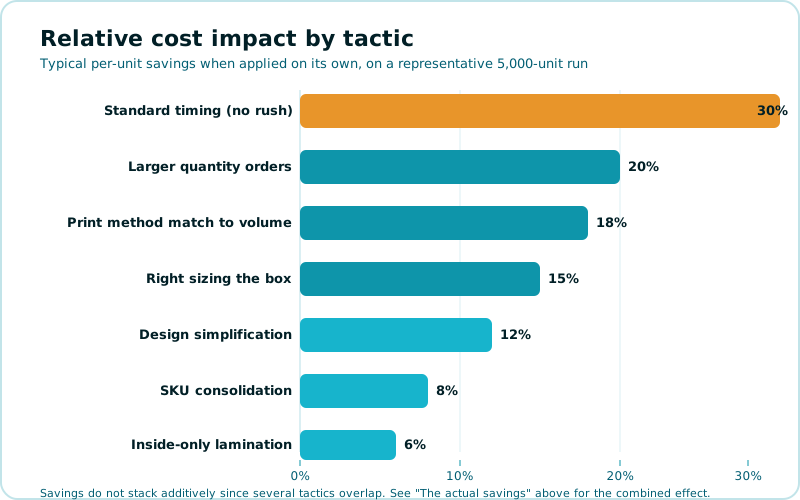
If you implement all seven tactics, the realistic savings on a 5,000 unit run looks like this:
| Tactic | Savings |
|---|---|
| Right sizing | 15 percent |
| Larger quantity orders | 20 percent |
| Design simplification | 12 percent |
| Print method match | 18 percent |
| SKU consolidation | 8 percent |
| Inside-only lamination | 6 percent |
| Standard timing (no rush) | 30 percent |
These do not stack additively, since some overlap. Even so, brands that put several of these tactics to work together consistently land well past what any single tactic delivers on its own, and the compounding effect tends to show up within the first two or three ordering cycles.
How to implement
Start with the two highest impact tactics: right sizing and matching print method to volume. They alone often cut 30 percent off your per unit cost. If you want to go deeper on materials, our packaging materials comparison breaks down where each option pays off.
Common questions on cutting packaging costs
How do I calculate dimensional weight (DIM weight) for my shipping box? Multiply length by width by height in inches, then divide by the carrier's dimensional divisor (commonly 139 for standard US domestic ground service, though the exact figure varies by carrier and service level). Compare that number to the box's actual weight. Carriers bill whichever number is higher, which is why an oversize box can cost more to ship even when the product inside barely weighs anything.
What quantity do I need to order before offset printing becomes cheaper than digital? Most standard mailer and folding carton jobs cross over somewhere between 500 and 1,000 units, depending on how many colors you are printing. A simple one or two color design crosses over earlier. A full four color CMYK design with Pantone spot colors needs more volume before the plate cost amortizes.
How much does a rush production surcharge actually cost on a custom packaging order? Plan on 25 to 50 percent above standard pricing, with the exact number depending on which stage you are compressing and how much capacity is available. Compressing artwork approval costs less than jumping the production queue itself. Our lead times and rush orders guide walks through the surcharge stage by stage.
Send us your current packaging spec and we will benchmark it against the optimization opportunities. We tell you specifically where you are overpaying and by how much. Free with every quote.