The first time a customer touches your physical product, they are touching the box. The bottle, the jar, the bar, the gadget, they all live one layer deeper. Custom packaging is no longer a finishing touch on the product. It is the first impression, the marketing channel, and the storage solution at once.
This guide is for direct to consumer founders, ecommerce marketers, and brand managers who need to brief custom packaging with confidence. Here is everything you need to think through before you submit your first quote.
Why packaging is now a marketing channel
The unboxing video has racked up tens of billions of views on YouTube alone. Add Instagram Reels and TikTok and the volume becomes uncountable. Every shipped order is a chance to land in a creator's feed or a customer's story. Brands that ignore this lose the channel by default.
Consumer research on unboxing and repeat purchase behavior circulates widely, but the specific figures shift by source, category, and year, so we will not lean on a single cited number here. The underlying behavior holds regardless of which survey you trust: a delightful unboxing builds the next purchase before the current product is even consumed.
Packaging also reduces returns. A box that arrives damaged generates refund requests, support tickets, and one star reviews. A box that protects the product earns a five star review and a referral. Brands that move from a generic shipping box to correctly sized, correctly flute-rated custom packaging tend to see fewer damage-related returns, simply because the box is engineered around the product instead of grabbed off a shelf.
The unboxing economy
For perspective, here are the categories where custom unboxing pays back the fastest:
- Beauty and skincare: Perceived value climbs noticeably when a folding carton is upgraded to a rigid box with soft touch lamination
- Subscription boxes: A custom printed mailer interior gives a renewal-driving brand a reason to feel premium on the third shipment, not just the first
- Apparel: Branded tissue inside a sturdy mailer, instead of a flat poly bag, reads as considered rather than careless when a garment arrives
- Premium electronics: Packaging that mimics the look and weight of category leaders lets a newer brand compete on shelf presence, not just price
The dollar value of better packaging is rarely the box itself. It is the second order on the customer, the referral to a friend, and the social content the customer creates for free.
Choosing your box style
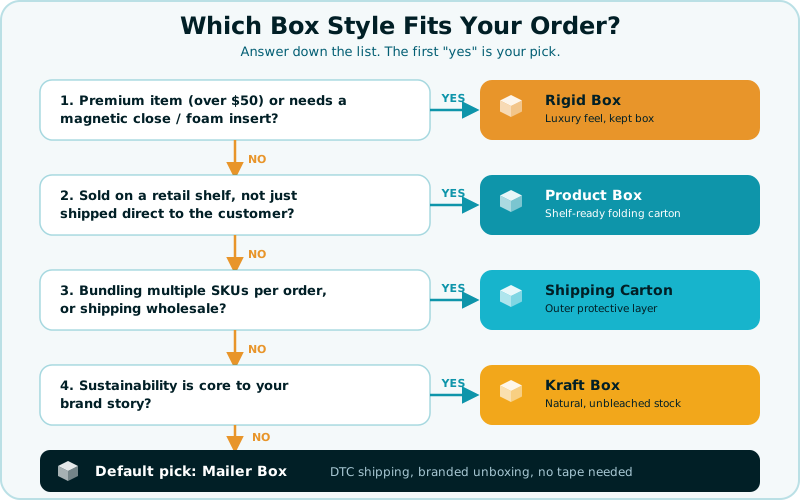
Twelve box styles cover almost every ecommerce product. Five of them handle 80 percent of orders.
Mailer boxes
The default for ecommerce. Tuck-end design with locking flaps. No tape required. Sizes from 4 by 4 by 4 inches up to 24 by 18 by 18 inches. Ideal for products under 5 lbs and under one cubic foot of total volume.
Choose mailer boxes when you want a printed exterior, a branded unboxing moment, and one-time-use shipping protection.
Product boxes
Tuck top folding cartons. The retail shelf standard. Sizes are fully custom and minimums start at 100 units for digital and 500 units for offset printing.
Choose product boxes when you sell in retail, when your product is small enough to fit inside a larger shipping carton, or when you want to break out individual SKUs from a larger order.
Rigid setup boxes
Heavy chipboard wrapped in printed paper. The packaging style luxury brands use to justify a price tag. Ships fully assembled.
Choose rigid boxes when you sell above 50 dollars per unit, when you want a magnetic closure or foam insert, or when your category leaders all use rigid packaging.
Shipping cartons
Standard Regular Slotted Containers in B-flute or C-flute corrugated. The outer layer of protection when you ship multiple items per order.
Choose shipping cartons when you are bundling multiple SKUs, when you ship wholesale to retail accounts, or when your primary packaging is too delicate to ship alone.
Kraft boxes
Available in mailer, product, and rigid variants. Made from unbleached kraft paperboard. Signals environmental commitment and craft positioning.
Choose kraft boxes when your brand identity centers on sustainability, natural ingredients, or artisan production.
Picking the right material for your product
The choice between SBS, kraft, corrugated, and rigid chipboard comes down to four questions. If you want a full breakdown first, read our packaging materials comparison.
- How heavy is your product? Anything over 5 lbs needs corrugated B-flute or heavier. Lighter products can use E-flute corrugated or paperboard
- How premium is your positioning? Above 50 dollars per unit, rigid chipboard pays back through perceived value. Below 30 dollars per unit, folding cartons are more economical
- What is your sustainability story? Kraft and CRB carry recycled content. SBS has lower recycled content but accepts brighter print
- How tightly do you need to control color? SBS reproduces brand colors most accurately. Kraft mutes colors and requires white underprint to keep them vivid
If you are still unsure, send your specs to our team and we will recommend a material on your free 3D mockup.
Printing options and what they cost
Three printing methods cover every project.
Digital printing has no setup costs. You can run 50 units economically. The trade-off is per unit cost stays roughly flat. There is no volume discount on plates because there are no plates. Choose digital for orders under 500 units.
Offset printing has a plate setup cost that gets amortized across your run. Per unit cost drops sharply above 500 units, again above 1000 units, and again above 5000 units. Choose offset for orders of 500 units and up.
Flexographic printing runs best on corrugated and kraft. Supports one to three spot colors. Lowest cost at scale. Choose flexo for shipping cartons at 1000 units or more.
Pantone color matching is available in offset and digital. Offset matches to a Delta E under 2. Digital matches to a Delta E of 3 to 5 which is commercial standard for most brand colors but not pixel exact.
Design tips for non-designers
You do not need a degree in graphic design to brief custom packaging. You do need to send the following.
- A logo file in vector format (AI or PDF), not a JPG or PNG
- Your Pantone color codes if you have them, or a hex code from your brand guide
- Reference photos of packaging you like and want to feel similar to
- The exact dimensions of your product measured at the widest, deepest, and tallest points
- One sentence about your brand voice so we can match the design tone to your product
If you have a designer on staff, they will appreciate working from a dieline we provide rather than building one from scratch. Ask us for the dieline at the same time you submit your quote.
How to order and what to expect
The order process from quote to delivery takes 14 to 25 business days depending on print method and quantity.
- Day 1: Submit quote request with product details
- Day 2 to 3: Receive detailed quote and free 3D mockup
- Day 3 to 5: Review the mockup, request changes, approve
- Day 5 to 20: Production runs
- Day 18 to 22: Quality inspection
- Day 20 to 25: Ships to your door
Rush production cuts this in half for an added fee. Plan ahead when you can.
Budgeting for custom packaging
Per unit cost depends on run size, material, and finishing, and it changes order to order, so we do not publish a fixed price list. As a general shape: small first-time runs sit in a budget-friendly tier, mid-size runs land in a mid-range tier as tooling and plate costs spread across more units, and large runs reach the most economical tier per unit even with premium finishing added on top.
A kraft mailer with a single color of print sits at the low end of any given run size. A soft-touch rigid box with foil stamping sits at the high end. For a full walkthrough of what drives the number up or down, read how much custom packaging actually costs.
FAQ
Do I need a designer to order custom packaging? No. Our team designs the dieline for free and creates a 3D mockup of your printed design at no cost with every quote.
Can I get a sample before placing a large order? Yes. We produce a single physical sample for a flat fee that credits toward your first production order.
What is the smallest order you accept? 50 units on most mailer and rigid box styles. 25 units on standard shipping cartons.
How long does production take? 7 to 10 business days for digital print runs. 15 to 20 business days for offset print runs.
What happens if my packaging arrives damaged? Inspect every shipment on arrival. Report damage within 48 hours with photos and we replace damaged units at no cost.
A few more questions before you request a quote
How do I measure my product before requesting a custom packaging quote? Measure the product at its widest point, its deepest point, and its tallest point, including any cap, pump, or protruding feature. Add clearance for void fill or an insert if the product needs cushioning. Send those three numbers with your quote request and we confirm dieline dimensions before production starts. Our step-by-step measuring guide walks through edge cases like irregular shapes and multi-item kits.
What's the actual difference between a mailer box and a shipping carton for my ecommerce order? A mailer box is the primary, branded packaging the customer sees and opens: printed exterior, tuck-lock closure, often printed inside too. A shipping carton is the outer protective layer, typically a plain RSC corrugated box, used when you are bundling multiple items, shipping wholesale, or adding a second layer of protection around a delicate mailer or rigid box. Many ecommerce orders only need a mailer. Multi-item and B2B orders often need both. Our mailer box versus shipping carton guide breaks down when to use each.
What is the minimum order quantity for a first-time custom packaging order, and why does it vary by box style? Most styles start at 50 units. Some, like display boxes or window boxes, start higher because the tooling behind them, die-cut windows and engineered fold structures, only pays back at a larger run. Simpler structures like kraft and mailer boxes stay accessible at 50 units because there is less tooling cost to amortize.
Ready to start
Custom packaging is one of the highest ROI investments an ecommerce brand can make. It reduces returns, raises perceived value, and creates content the customer shares without being asked.
Send us your product and your quantity to get a free quote. We will get back to you within 48 hours with a detailed quote and a free 3D mockup of your packaging.