Most growing brands reach the same crossroads once orders start moving at volume: do we ship in a printed mailer box or a plain shipping carton? The answer is not universal. It depends on your product weight, your brand positioning, your average order value, and whether the box your customer opens is the same box that left your warehouse.
This guide breaks down both options across every dimension that matters so you can make the call with confidence. If your product sits at the premium end of the market, a third structure is worth a look before you decide: our rigid box versus mailer box comparison covers when the extra cost is justified.
What is a mailer box?
A mailer box is a single-piece corrugated box with locking tuck flaps that holds itself closed without tape. It is built for direct to consumer shipping. The inside and outside surfaces are fully printable, which makes it the primary unboxing vehicle for ecommerce brands that care about the first physical impression.
Construction is almost always E-flute corrugated, which sits at roughly 1.5 mm to 2 mm thick. That thickness gives good crush resistance for orders under 5 lbs while keeping the box lightweight enough to stay inside most carrier weight tier thresholds.
Key traits:
- No tape required, self-locking flaps
- Full exterior and interior print possible
- E-flute standard (B-flute available for heavier products)
- Ships as a finished retail unit, no secondary outer packaging needed
- Minimum order typically 50 to 100 units
What is a shipping carton?
A shipping carton is a Regular Slotted Container, the classic brown box. Four flaps meet in the middle on the top and bottom, sealed with tape or glue. It is engineered for protection and stacking, not brand presentation. Construction is B-flute or C-flute corrugated, which is meaningfully heavier and stiffer than E-flute.
Shipping cartons handle the physical abuse of freight networks. They stack. They withstand pallet pressure. They ship products that weigh 10, 20, or 50 lbs without flexing in the center. Branding on a shipping carton is typically limited to a one or two color flexographic print on the outside or a plain kraft surface with a label.
Key traits:
- Tape-sealed, classic RSC fold pattern
- B-flute or C-flute standard
- Rated for heavier loads and stacking
- Designed as an outer shipping layer, not a retail presentation layer
- Minimum order typically 25 to 50 units
The corrugated flute breakdown
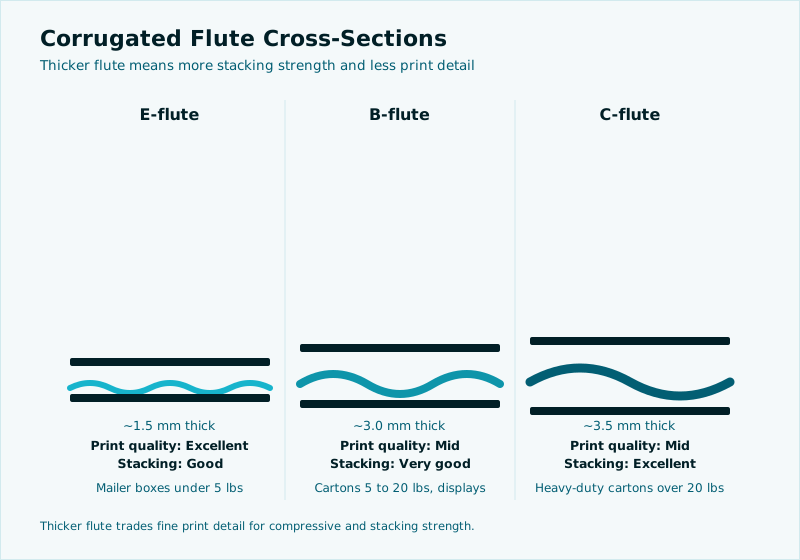
The flute is the wave-shaped layer inside the corrugated board. Flute size determines thickness, stacking strength, and printability. These three grades cover almost all packaging use cases.
| Flute | Thickness | Stacking Strength | Print Quality | Best Use |
|---|---|---|---|---|
| E-flute | 1.5 mm | Good | Excellent | Mailer boxes under 5 lbs, retail cartons |
| B-flute | 3.0 mm | Very Good | Mid | Shipping cartons 5 to 20 lbs, display units |
| C-flute | 3.5 mm | Excellent | Mid | Heavy-duty shipping cartons over 20 lbs |
E-flute is the default for custom printed mailer boxes because the fine flute profile lets ink and die cutting deliver clean, sharp results. The tradeoff is less stacking resistance than B or C. If you are shipping products over 5 lbs in a mailer box, ask about B-flute construction. The box will be slightly heavier but the crush protection difference is substantial.
For more on how material grade affects your packaging decisions across substrates, read our packaging materials guide.
Protection: which one keeps your product safer?
Shipping cartons win on raw structural protection. The thicker flute absorbs more compressive force, resists puncture better, and holds shape through multiple handling cycles in a freight network.
Mailer boxes protect adequately for the vast majority of ecommerce products, particularly anything under 5 lbs that ships in a well-fitted box with appropriate void fill. The risk area is crush resistance under stacking loads. A pallet of 200 mailer boxes under freight pressure will compress more than a pallet of shipping cartons at the same stack height.
The fit matters as much as the material. A product rattling inside an oversized carton will arrive damaged more often than the same product packed snugly inside a mailer box built to its dimensions. Get the box size right and E-flute mailer boxes perform well for the typical direct to consumer order.
If your product is:
- Fragile or heavy: lean toward B-flute or C-flute shipping cartons
- Light and rigid: E-flute mailer boxes protect well
- Shipping inside a primary retail carton already: the outer shipping box can be a plain carton, the branded mailer box lives inside
For products that need engineered cushioning beyond flute choice alone, glass, ceramics, electronics with sensitive components, see our guide on choosing packaging for fragile products.
Branding and the unboxing experience
This is where mailer boxes win outright. A shipping carton is a logistics tool. A mailer box is a marketing channel.
The outside of a mailer box is a full-bleed print surface. The inside is too, and the full range of printing and finishing options applies to both surfaces. Brands print their tagline on the inside lid. They print a pattern on the inside base. They tuck a thank you card under the lid so it is the first thing the customer sees. That experience is structurally impossible on a standard shipping carton.
The unboxing moment is particularly high value for:
- Beauty and cosmetics brands whose customers regularly film their purchases
- Subscription products where the renewal decision happens at the box
- Gift-intent products where the recipient is not the buyer
- Premium products where the packaging needs to justify the price
If your customer opens the box in front of other people, or photographs it before they use it, you are shipping in a mailer box.
Cost comparison
Direct cost comparison varies by quantity, print method, and box dimensions, so a single number never tells the full story. What holds steady across runs is the relative pattern for a typical box in the 10 x 8 x 4 inch range.
| Box Type | Relative Cost Tier | |
|---|---|---|
| Mailer box (E-flute, 1 color exterior) | Digital | Mid |
| Mailer box (E-flute, full CMYK + inside print) | Digital | Mid to premium |
| Mailer box (E-flute, full CMYK, 2,000+ units) | Offset | Mid, drops with volume |
| Shipping carton (B-flute, plain kraft) | None | Budget |
| Shipping carton (B-flute, 1 color logo) | Flexo | Budget to mid |
A plain shipping carton starts cheaper than any printed mailer box at low quantities. That gap narrows substantially at volume: a full-color offset printed mailer box at 5,000+ units is not dramatically more expensive than a branded shipping carton at the same run, and the marketing value difference is significant. For a full breakdown of what actually drives packaging cost up or down, read how much custom packaging costs.
Factor in the full picture. A plain shipping carton often requires additional branded inserts, tissue paper, or stickers to create any brand moment, which adds cost and fulfillment time. A mailer box delivers the brand moment structurally.
Which one should you use?
Neither option is universally right. Pick based on what the box actually does in your operation.
Use a mailer box when:
- You ship direct to consumer and the customer opens this box
- Your average order value is above $30
- Your product weighs under 10 lbs
- You want an unboxing moment without adding inserts
- You are selling to beauty, wellness, or apparel customers who share purchases online
Use a shipping carton when:
- You ship wholesale to retail accounts where the carton is a logistics vehicle
- Your products weigh over 15 lbs
- You are shipping a secondary outer box and the branded packaging lives inside
- Your margins are tight and print cost needs to stay minimal
- You need maximum stacking strength for palletized freight
Use both when:
- Your branded mailer box goes inside a plain shipping carton for extra protection on heavy or fragile orders
- You sell B2B and B2C simultaneously, with cartons for bulk orders and mailer boxes for consumer orders
Getting your box spec right
Once you know which direction you are heading, the next step is locking in dimensions, flute grade, and print spec. A box that is too large wastes material and invites product movement. A box that is too small damages your product at the seams.
We will help you size it correctly. When you request a quote, include your product dimensions measured at the widest, deepest, and tallest point, plus the weight. If you are not sure how to take those measurements correctly, our guide on how to measure your product for a custom box walks through it step by step. Our team will recommend flute grade, confirm sizing, and send you a free 3D digital mockup within 48 hours.
For brands still exploring the full range of custom box styles before committing to a direction, the catalog covers every format from display boxes to rigid setup boxes. The right structure for your product is in there.
Common questions about mailer boxes and shipping cartons
Can I ship fragile or breakable products safely in a mailer box, or do I need a shipping carton? A well-fitted E-flute mailer box protects most fragile items under 5 lbs, provided the box is sized snugly and packed with appropriate void fill so the product cannot shift in transit. Glass, ceramics, and anything with sensitive internal components benefit from B-flute or C-flute construction, or from shipping the branded mailer box inside a plain outer carton for a second layer of cushioning. The deciding factor is fit and cushioning, not just flute grade.
What size mailer box or shipping carton do I need for my specific product dimensions? Measure your product at its widest, deepest, and tallest point, then add clearance for void fill, roughly a quarter inch to a half inch per side depending on how much cushioning your product needs. An oversized box lets the product shift and arrive damaged; an undersized one stresses the seams. Our team confirms exact sizing as part of every quote, using your measurements and the fill method you plan to use.
How much does a custom shipping carton cost at 1,000+ units compared to 500? Per-unit cost drops as quantity rises because fixed setup costs (plates, dies, press makeready) get divided across more units while material and labor cost per box stays roughly flat. The exact drop depends on flute grade, print method, and box size, so request a quote with both quantities to see the real numbers for your spec side by side.