Fragile products fail in transit for one of three reasons: the box collapses under stack weight, the product moves inside the box during handling, or the impact force has nowhere to go but through your product. Fix all three and your damage rate drops. Miss any one of them and you are paying for replacements, refunds, and reputation repair.
This guide covers the structural decisions that matter before you finalize your packaging spec. Flute grade, box style, insert type, and dimensional fit are not cosmetic choices. They determine whether a bottle arrives intact after a two-day carrier journey or a warehouse drop.
Corrugated vs. Rigid: Start With the Right Outer Shell
The outer box sets the ceiling on how much protection is even possible. Two structures dominate fragile-product shipping.
Shipping cartons are the workhorses for e-commerce and wholesale fragile shipments. They are made from corrugated board: a fluted medium sandwiched between flat liners. The flutes absorb compressive and impact energy. The liner resists puncture and holds print.
Rigid boxes are chipboard-core constructions with no fluting. They are stiffer, feel premium, and protect against crushing during light transit, but they are not designed for the drop heights or stack weights that corrugated handles. Rigid boxes work best when the outer shipping carton handles the transit stress and the rigid box is the retail presentation layer inside.
For anything fragile shipping direct-to-consumer or through a carrier network, a corrugated outer is the right starting point. The rigid box, if needed, goes inside.
Flute Selection: E vs. B vs. Double-Wall
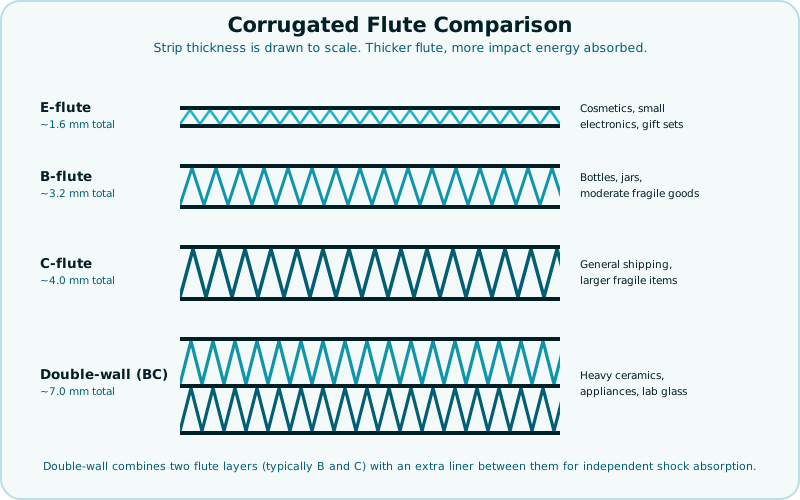
Corrugated board comes in several flute profiles. The flute determines crush resistance, shock absorption, and how much printable surface area you get.
| Flute | Thickness | Best For | Trade-Off |
|---|---|---|---|
| E-flute | ~1.6 mm | Cosmetics, small electronics, gift sets | Lower stack strength than B or C |
| B-flute | ~3.2 mm | Bottles, jars, moderate fragile goods | Less flat-print clarity than E |
| C-flute | ~4.0 mm | General shipping, larger fragile items | Bulkier, heavier than E/B |
| Double-wall (BC) | ~7.0 mm | Heavy ceramics, appliances, lab glass | Adds weight and cost, justified for high-value items |
E-flute is the default for cosmetics and small consumer electronics. It is thin enough to print cleanly and rigid enough for stacking on a shelf. A serum bottle in a well-designed E-flute box with a paperboard insert handles normal e-commerce transit.
B-flute absorbs more impact energy. It is the right call for glass bottles and ceramic pieces where a single drop could mean a total loss. The thicker flute compresses to dissipate energy before the force reaches the product.
Double-wall corrugated (typically a BC or EB combination) is for when a single-wall failure is unacceptable. Think handmade ceramics, heavy cast-iron items, or laboratory glass. The two fluted layers act independently, so the outer layer can take a significant hit and the inner layer still protects the contents.
See the full breakdown of board grades at the materials guide.
Inserts: Foam, Molded Pulp, and Paperboard
The outer box stops external force. The insert stops internal movement. These are different problems with different solutions.
Foam inserts (polyethylene, polyurethane, cross-linked PE) cut to fit your product's exact footprint. They are the highest-performing option for electronics and high-value cosmetics because the foam compresses under impact and distributes force across the widest possible surface area. Custom-cut foam eliminates all movement. The trade-off is cost per unit and recyclability concerns.
Molded pulp inserts are pressed paper fiber formed to product shape. They are rigid enough to hold position and sustainable enough to satisfy buyers who care about packaging materials. Molded pulp works well for cosmetics, light electronics, and food-grade items. It does not perform as well as foam under repeated or severe drops, but for most e-commerce use cases it is more than adequate.
Paperboard die-cut inserts (sometimes called fitments or trays) are the right call for organized presentation within a retail or mailer box. Paperboard dividers keep bottles separated. Sleeve inserts hold tubes or pens upright. They are the lowest-cost insert option and work fine when the product is not highly impact-sensitive.
For mailer boxes shipping cosmetics or small electronics, a die-cut paperboard insert that cradles the product is often all you need, provided dimensional fit is correct.
Void Fill and When It Fails
Void fill (paper, air pillows, foam peanuts) is a gap-filler, not a protection system. It works when:
- The product is in its own retail box or sub-carton
- The outer shipping box is only slightly oversized
- The product is not highly fragile
Void fill fails when the box is significantly oversized and the product can travel more than an inch or two in any direction. A glass jar wrapped in paper fill inside a box that is four inches too wide will rattle during carrier sorting, and rattling under drop conditions breaks glass. Void fill does not replace a fitted insert. Use it for incidental gap-filling only.
Suspension and Retention Packaging
Suspension packaging uses film or board to hold the product floating inside the box, away from all walls. The product does not touch the box sides. Retention packaging uses a similar principle, with film stretched across a frame that holds the product in tension.
These systems are common in electronics retail. The plastic clamshell that holds a hard drive suspended between two board frames is a retention system. They are expensive to design and tool but nearly eliminate contact-surface damage. If you are shipping a high-value item where even a cosmetic scratch triggers a return, suspension or retention packaging is worth pricing out.
Drop-Test Thinking and ISTA-Style Evaluation
Carriers do not handle packages gently. Ground packages experience drop heights ranging from 18 to 36 inches in normal sortation. ISTA (International Safe Transit Association) test protocols simulate these conditions across drop, vibration, and compression dimensions.
You do not need to run formal ISTA testing for every SKU, but the thinking applies:
- Drop test your prototype by hand before ordering production quantities. Drop from 30 inches onto each face, each edge, and each corner. If anything breaks, your protection system is insufficient.
- Compression test by stacking boxes as they would be stacked on a pallet or in a warehouse. E-flute boxes compress under 200 to 300 lbs of stack load. Double-wall holds significantly more.
- Vibration is less intuitive but matters for road freight. Products that are fine after a drop can fail after six hours of truck vibration against an ill-fitting insert.
Formal ISTA or ASTM testing is worth running if you ship freight, if your damage rate is above 1 to 2%, or if a carrier certification is required by a retail buyer.
Dimensional Right-Sizing: The Most Underrated Protection Variable
A box that is too large for its contents is one of the most common causes of fragile product damage. Product movement inside an oversized box means the product is effectively being thrown against the walls on every impact.
The target for a fitted insert system is zero movement. The product should not shift when the box is shaken vigorously. If it shifts, the insert is undersized or the box is oversized.
Dimensional right-sizing also reduces dimensional weight charges from carriers, which is a direct cost saving. A box that is two inches shorter in each dimension can drop your carrier tier on small parcels. For high-volume shippers this adds up quickly.
For help specifying the right box dimensions for your product, the guide on how to measure a product for a custom box covers the process step by step.
Printing and Finishing on Fragile-Product Boxes
Fragile product packaging often has a dual job: protect in transit, present on arrival. The printing and finishing options available on corrugated and rigid boxes let you run a full-color branded exterior on a shipping carton or gift box without sacrificing structural performance.
Matte lamination on an E-flute mailer creates a retail-quality unboxing experience. Spot UV on a rigid lid adds premium feel for cosmetics. Neither finish compromises protection when the substrate and insert are specified correctly.
Fragile packaging questions we hear most
How much does a custom foam insert cost compared to molded pulp? Foam inserts cost more per unit than molded pulp because the cutting process is more labor-intensive and the material itself carries a higher base cost. Molded pulp closes most of that performance gap for cosmetics and light electronics at a lower price point, which is why most e-commerce brands default to pulp unless the product is high-value or highly impact-sensitive. Exact numbers depend on insert complexity and volume; our guide to what custom packaging costs explains the variables that move the price.
What is the minimum order quantity for double-wall corrugated or foam inserts? Minimums run higher than standard single-wall boxes because double-wall corrugated and custom-cut foam both require more setup per run. Expect a higher floor than the 50-unit minimum on standard box styles. Our guide to minimum order quantities breaks down how minimums shift by material and complexity.
Which box style should I choose for glass candle jars or ceramics? A shipping carton in B-flute or double-wall corrugated, paired with a molded pulp or foam insert sized to the jar, is the standard combination for glass and ceramics. Our guide to packaging by product type covers box and insert recommendations across categories in more detail.
Get a Quote and a Free 3D Mockup
If you have a fragile product and a damage rate you want to bring down, or if you are launching a new SKU and want to get the protection spec right from the start, the fastest path is a free quote with a 3D mockup included.
Describe the product dimensions, the fragility level, and the shipping method. The team turns that into a box and insert specification with a 48-business-hour quote turnaround. Minimum orders typically start at 50 units depending on the box style.
You can also request a physical sample of the box style you are considering before committing to a production run. The sample fee credits toward your first order.