Most brands want sustainable packaging. Fewer know what that actually means at the production level. "Eco-friendly" has been stretched so far by marketing teams that it now covers everything from 10% post-consumer content to certified compostable films, and buyers are left comparing apples to lumber.
This guide cuts through that. It covers the real material options, their actual environmental profiles, and the trade-offs you face when you pick one over another. No invented case studies, no vague pledges. Just the mechanics of each choice so you can make a defensible decision for your brand. For the regulatory and consumer-demand backdrop driving all of this, see our 2026 sustainable packaging trends overview.
The Highest-Impact Lever Nobody Talks About: Right-Sizing
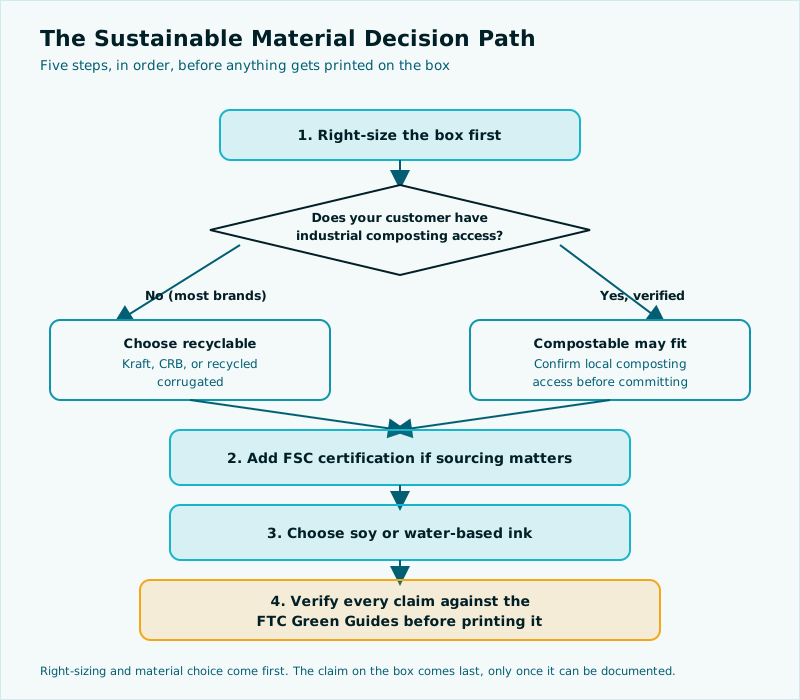
Before you evaluate any material, look at your box dimensions. An oversized box filled with void fill creates more waste than a well-fitted box made from virgin board. This shows up most visibly in mailer boxes, the format most often sized well beyond the product it ships. Right-sizing is the single highest-impact sustainability move available to most brands, and it costs nothing extra.
A box that fits your product snugly:
- Reduces total material weight across every shipment
- Eliminates void fill (air pillows, paper dunnage, foam peanuts)
- Cuts dimensional weight charges from carriers, which directly reduces packaging costs
- Increases pallet density, lowering freight emissions per unit
Get the dimensions right first. Then choose your substrate.
Recycled-Content Corrugated: The Workhorse Option
Corrugated is already one of the most recycled materials in the US supply chain, with recovery rates consistently above 90%. When you specify recycled-content corrugated, you are buying board made from recovered fiber (old corrugated containers, mixed paper) rather than virgin pulp.
What to know:
- Standard recycled-content corrugated uses 70-100% post-consumer or post-industrial fiber
- Strength ratings (ECT, burst test) are fully achievable with recycled board for most DTC and ecommerce applications
- The liner and medium can be specified separately; a recycled medium with a virgin kraft liner is common for boxes needing better print quality on the outside
- Recycled board is not inherently weaker for typical product weights under 30 lbs
Trade-off: High-moisture environments, very heavy products, or aggressive stacking requirements may need higher ECT ratings, which can push toward virgin kraft or a blended board. Talk to your packaging supplier about the actual load specs before assuming recycled board cannot handle your application.
Explore corrugated shipping formats at /custom-boxes.
FSC-Certified Paperboard: What the Certification Actually Means
FSC (Forest Stewardship Council) certification means the virgin fiber in the board was sourced from forests managed to specific environmental and social standards. It does not mean the material is recycled. It does not mean it will biodegrade faster. It means the supply chain for that virgin pulp was audited.
When FSC-certified board makes sense:
- Retail shelf packaging where print quality and structural rigidity matter (rigid boxes, folding carton for beauty or wellness products)
- Brands selling into retail channels that require or reward chain-of-custody documentation
- Situations where recycled fiber cannot meet the surface quality needed for high-end lithographic printing
When it does not add much: If your box ends up in a recycling bin after the consumer opens it, FSC certification signals responsible sourcing but does not change the end-of-life story. The certification has real value at the forest level; it is not a substitute for thinking about recyclability at the consumer end.
See how FSC-certified substrates compare to other options on our materials guide.
Uncoated Kraft: Honest Material, Real Trade-Offs
Natural kraft, the brown uncoated paper made from softwood pulp with high lignin retention, is one of the most recyclable packaging materials available. It is also one of the most overused sustainability props in DTC packaging.
What kraft actually delivers:
- Fully curbside recyclable in virtually every US municipal program
- No clay coating means no contamination issues at the recycling facility
- Natural texture and color signal sustainability to consumers without printing a word about it
- Kraft boxes work well for mailers, retail bags, hang tags, and lightweight folding cartons
Honest limitations:
- Kraft is not water-resistant without a coating, and adding a coating (even water-based) can complicate recyclability depending on the thickness applied
- Print reproduction on natural kraft is limited to earthy tones and a narrow color gamut. Bright whites and photographic imagery are not realistic on uncoated kraft
- Structural rigidity per gram is lower than some coated boards, so you may need heavier caliper to achieve the same box rigidity
For a deeper look at how kraft compares to other substrates, see our packaging materials comparison.
Soy-Based and Water-Based Inks: The Print Side of Sustainability
The substrate is only half the story. Conventional petroleum-based inks contain volatile organic compounds (VOCs) and can complicate the recyclability of the board they are printed on if used in heavy coverage.
Soy-based inks:
- Replace petroleum oils with soy oil as the carrier, reducing VOC emissions during printing
- Perform comparably to conventional inks on offset lithographic presses
- Improve de-inkability during paper recycling, which is relevant for recycling mills
- Are not automatically better for flexographic or digital printing processes. The benefit is most relevant for offset litho
Water-based inks:
- The standard for corrugated flexographic printing and a strong choice for kraft and recycled board
- Lower VOC content than solvent-based alternatives
- Dry by absorption rather than chemical reaction, which works well with uncoated stocks
What to avoid claiming: Ink choice alone does not make a package eco-friendly. It is one factor in a system. Stating that your packaging uses soy inks is accurate and worth noting. Presenting it as a primary sustainability credential is greenwashing.
Learn more about print options at /printing-finishing.
Compostable vs. Recyclable: A Trade-Off Most Brands Get Wrong
Compostable packaging sounds like the highest environmental standard. In practice, the end-of-life infrastructure matters as much as the material certification.
| Compostable | Recyclable | |
|---|---|---|
| End-of-life requirement | Industrial composting facility | Curbside recycling bin |
| Consumer infrastructure | Available in a small minority of US zip codes | Available to the large majority of US households |
| If disposed incorrectly | Goes to landfill, where it does not compost | Goes to landfill, but does not break down and release methane |
| Print compatibility | Limited; many compostable films and papers require specific inks | Broad compatibility |
| Cost vs. standard board | Significantly higher | Comparable or slightly above standard |
| Best use case | Food-contact items, brands with verified compost access in their market | Most DTC, retail, and ecommerce applications |
For most brands shipping to US consumers, a right-sized, curbside-recyclable box made from recycled-content corrugated or kraft will outperform a compostable mailer in actual environmental outcomes, because consumers can act on it with no special infrastructure. For the cost mechanics behind that "significantly higher" row in the table, see our breakdown of what drives custom packaging cost.
Mono-Material Design: The Recyclability Principle Behind the Spec
Mixed-material packaging, where a paper box has a plastic window, a laminated interior, or a foam insert, creates separation problems at the recycling facility. When materials cannot be easily separated, the whole unit often gets rejected.
Mono-material design means:
- Specifying a single substrate family throughout the box (paperboard only, or corrugated only)
- Replacing plastic windows with die-cut openings or glassine (a recyclable paper alternative)
- Avoiding foam inserts in favor of custom-fit corrugated partitions or molded pulp
- Selecting tissue paper or kraft paper over polyethylene tissue for interior wrap
Window boxes can still be designed with recyclability in mind. The key is using a thin, water-soluble adhesive and a PET window that is easy for the consumer to separate before recycling, rather than a laminated window that cannot be separated at all.
A practical sustainability commitment, as we detail on our sustainability page, means specifying mono-material construction wherever the structural and visual requirements allow it.
How to Evaluate a Claim Before You Print It on Your Box
The FTC Green Guides give specific guidance on what US brands can and cannot say without qualification. A few rules of thumb:
- "Recyclable" requires that a substantial majority of consumers have access to recycling facilities for that material. Most paper and corrugated passes. Thin plastic films and laminated structures do not.
- "Made with recycled content" must specify the percentage. Stating "made with recycled content" alone, without a number, is not sufficient.
- "Compostable" requires qualification if industrial composting is required. You must disclose that if home composting is not possible.
- "Carbon neutral" or "carbon offset" claims require third-party verification and ongoing disclosure.
Do not print a claim on your box that you cannot document with a supplier spec sheet or third-party certificate. It is not worth the legal or reputational exposure.
Common questions about sustainable material choices
Does choosing sustainable materials raise or lower the minimum order quantity? The material itself does not change your MOQ. Recycled-content corrugated and kraft run the same minimums as their virgin-fiber or SBS equivalents on the same box style, typically 50 units on most styles. What raises MOQ is added complexity, foil stamping, a specialty coating, a compostable film, not the recycled content or FSC certification. See our minimum order quantities guide for how MOQ actually scales by construction and finish.
What is the actual cost premium in dollars for recycled-content corrugated versus standard? There usually isn't one. Recycled-content corrugated is the dominant supply in the US market, with recovery rates above 90%, so it typically prices at or near parity with virgin-fiber board rather than carrying a premium. Where cost does rise is when you need a higher ECT (strength) rating than standard recycled board delivers for very heavy or high-moisture applications, which can push toward a blended or virgin-heavy spec. Request a quote with your actual weight and stacking requirements to see where your project lands.
How do 2026 state packaging regulations affect which sustainable materials I should choose? Extended Producer Responsibility laws in California, Oregon, Colorado, Maine, and Minnesota now attach direct fees to non-recyclable packaging, plastic windows, mixed-material laminates, metallized films, while recyclable paperboard and corrugated do not carry those fees. If you ship nationally, designing to the most restrictive state's rules and shipping that spec everywhere is simpler and often cheaper than maintaining state-specific packaging.
Start With a Quote and a Free 3D Mockup
If you are ready to specify your materials, every quote includes a free 3D mockup so you can see exactly how your chosen substrate and print method will look before a production plate is cut. Minimum orders typically start at 50 units, and we ship to all 50 US states.
Request your quote at /get-quote, or if you want to test a physical sample before committing to a run, order a sample first at /get-a-sample. Sample fees credit toward your first production order.