If you sell on Amazon FBA, your packaging does two jobs simultaneously: it has to survive Amazon's fulfillment network and it has to represent your brand the moment a customer opens the box. Getting either one wrong is expensive. Getting both right is a competitive advantage that most sellers overlook.
This guide covers the FBA packaging requirements that matter, the prep standards Amazon enforces, and how to build custom branded packaging that works inside the FBA system without triggering rejections or receiving chargeback fees. For a broader look at how ecommerce brands structure their packaging decisions, see our guide on mailer boxes vs shipping cartons.
Why FBA packaging requirements exist
Amazon's fulfillment centers process millions of units a day across automated conveyor systems, robotic pick stations, and human sorters. A box that is too heavy, too oddly shaped, or missing a required label gets pulled from the line and either rejected, assessed a prep fee, or returned to the seller at cost.
The requirements exist to keep the fulfillment operation running. Amazon does not care about your brand preferences. If your unit cannot be scanned, sorted, and shelved efficiently, it becomes a problem they charge you to solve. Understanding the rules upfront means you build packaging that moves through the system without friction.
FNSKU labels: the most important label on your product
The Fulfillment Network SKU (FNSKU) is Amazon's internal identifier that ties a specific product unit to your seller account. It is not the same as a UPC or ASIN. The FNSKU is what Amazon scans at the receiving dock to count your inventory and at the pick station to confirm the right item is being pulled for an order.
Every unit sent to FBA must have a scannable FNSKU label affixed to the exterior. Amazon's requirements for the label:
- Minimum label size: 1 x 2 inches
- Barcode must be scannable at a standard distance (do not print at too low a resolution)
- Label must be placed on a flat, non-reflective surface
- Label must not be placed on a seam, fold edge, or curved surface that distorts the barcode
- If the product already has a manufacturer barcode, the FNSKU label must cover it completely
You have two options for applying FNSKUs. You apply them yourself before shipping to the fulfillment center (seller-labeled), or you pay Amazon a per-unit fee to apply them at the FC (Amazon-labeled). At any volume above a few hundred units per month, applying them yourself is materially cheaper. Custom packaging that integrates the FNSKU placement into the dieline design makes self-labeling faster and cleaner.
Suffocation warning requirements
Any poly bag with an opening larger than 5 inches must carry a suffocation warning. Amazon requires this for all poly-bagged units entering the fulfillment network, regardless of what your retail packaging already shows.
The warning must be:
- Printed directly on the bag or on a label affixed to the bag
- In a font size of at least 10 points for bags up to 60 inches in circumference, larger for bigger bags
- In English (and French or Spanish if you sell on those storefronts)
A standard acceptable wording is: "WARNING: To avoid danger of suffocation, keep this plastic bag away from babies and children. Do not use this bag in cribs, beds, carriages or playpens."
If your product ships in a poly bag for FBA, this is non-negotiable. If you are moving away from poly bags toward rigid custom boxes, you eliminate this requirement entirely while also improving your brand presentation. Brands in health and wellness and beauty and cosmetics frequently make this switch at the point where FBA volume justifies a minimum order run.
Box size and weight limits
Amazon's standard FBA box requirements for standard-size shipments:
| Requirement | Limit |
|---|---|
| Maximum box weight | 50 lbs |
| Maximum box length | 25 inches |
| Maximum box length + girth combined | 165 inches |
| Minimum box dimension (any side) | No minimum specified, but units must be individually scannable |
| Oversize threshold (single unit) | Longest side over 18 in, or weight over 20 lbs |
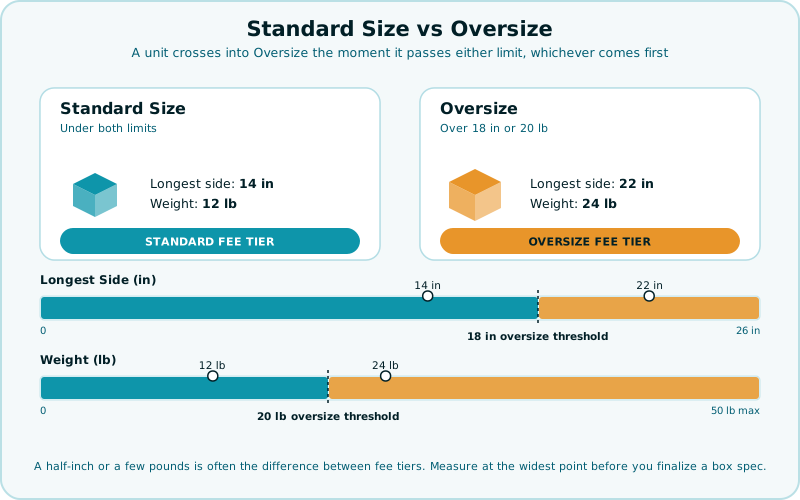
Units that exceed the oversize threshold enter the Oversize tier, which carries higher fulfillment fees. If your product sits close to the oversize line, a packaging redesign that shaves an inch off the longest dimension can move you into the lower standard-size fee tier. That savings compounds across every unit sold.
Getting this right starts with an accurate measurement of your product, not the box. See our guide to measuring your product for a custom box for the full process, including how much clearance to add before you check the result against Amazon's limits.
Master cartons (the outer shipping box containing multiple units) must also stay under 50 lbs. If a single master carton of your product would exceed 50 lbs, you need to split the quantity across two lighter cartons.
Poly bag vs rigid box: when to use each
Poly bags and rigid boxes solve different problems inside FBA. The choice depends on your product's shape, fragility, and brand positioning.
Poly bags work for:
- Soft goods (apparel, fabric items, plush)
- Items that are not fragile and have no sharp edges
- Products where the retail packaging is already a sturdy box and the poly bag is just a dust or tamper barrier
- Low-margin products where the per-unit packaging cost needs to stay minimal
Rigid custom boxes work for:
- Any product where the retail presentation matters
- Fragile items that need structural protection
- Products with sharp or irregular edges that would puncture a poly bag
- Brands building for repeat purchase, where the unboxing experience drives customer loyalty
For ecommerce brands running FBA alongside their own website or retail channels, a single well-designed custom box handles all three channels without the cost of running separate poly-bag and retail packaging lines. The FNSKU label goes on the box, the box ships direct to the FC, and the same box is what your Amazon customer opens.
Our custom mailer boxes are E-flute corrugated and work directly inside Amazon's system when sized and labeled correctly. For heavier products or bulk-packed units, shipping cartons in B-flute or C-flute handle the structural requirements.
Master carton prep and unit count labeling
When you ship a pallet or multiple cartons to an FBA fulfillment center, each master carton needs a shipment label generated through Seller Central. Beyond that label, Amazon expects:
- A packing list or box content information submitted through Seller Central before the shipment arrives
- Each carton labeled with its contents, quantity per carton, and your shipment ID
- No mixed SKUs in a single carton unless you have multi-SKU stickers on each unit and the box content information reflects the mix
Keeping one SKU per master carton is the cleanest approach operationally. It eliminates receiving errors at the FC and makes your inventory reconciliation straightforward.
Minimum order quantities from MetaSys start at 50 units for most box styles, which aligns well with FBA initial test shipments and reorder cadences once you have velocity data. See our guide to minimum order quantities for how minimums shift by box style and material.
How branded packaging works within FBA rules
Amazon does not prohibit custom branded packaging. It does not require you to ship in plain brown cartons. The constraint is labeling, not aesthetics.
A custom printed box with your logo, brand colors, and product photography moves through the FBA system exactly the same as a plain brown carton, as long as it meets the dimensional and weight requirements, carries the correct FNSKU label, and is properly registered in your shipment plan. Amazon scans the FNSKU, counts the unit, and shelves it. Your branding is irrelevant to that process.
What the branding does affect is what happens after Amazon picks the unit and ships it to your customer. That customer receives your branded box, not an Amazon box, which is a significant retention signal for high-repeat categories.
For printing and finishing options that work within FBA constraints, soft-touch laminate, spot UV, and foil stamping all hold up through fulfillment center handling without delaminating or marking. Avoid finishes that are easily scuffed or that require careful storage conditions if your units will sit in an FC for extended periods.
FBA packaging compliance checklist
Use this before finalizing your packaging spec for FBA:
| Requirement | Notes |
|---|---|
| FNSKU label affixed to flat, non-reflective surface | Covers any existing manufacturer barcode |
| Barcode scannable, minimum 1x2 inch label size | Print at 300 dpi or higher |
| Box weight under 50 lbs | Per unit and per master carton |
| Box dimensions within 25 inch max per side | Check longest side first |
| Suffocation warning on any poly bag over 5 inch opening | 10+ point font |
| No loose parts that could detach inside the FC | Poly-bag or secure any loose accessories |
| Master carton labeled with shipment ID, SKU, quantity | Via Seller Central shipment plan |
| Box content information submitted before shipment arrival | Required for inventory accuracy |
| Product protected from damage through automated conveyor systems | Test by dropping the box on each face from 18 inches |
Getting your FBA packaging right from the first order
The most common mistake FBA sellers make is treating packaging as an afterthought until they get hit with a prep fee or a rejection. Building to spec from the start costs the same as building wrong, and it eliminates the per-unit fees Amazon charges to fix non-compliant units.
When you request a quote from MetaSys, tell us you are selling on Amazon FBA. We account for FNSKU label placement in the dieline, confirm your dimensions stay inside the 25-inch limit, and provide a free 3D mockup so you can confirm the label placement and branding before a single unit goes into production. Quotes are human-reviewed and we respond within 48 business hours. If you are working against an Amazon inventory deadline, our guide to packaging lead times and rush orders covers how to plan production around a launch date.
FBA packaging questions we hear most
How much does custom FBA-compliant packaging cost per unit? Cost depends on box style, dimensions, substrate, and print spec, not a flat per-unit number. An E-flute mailer with a one-color logo runs less than a full-color offset carton with foil stamping. FNSKU placement and dimensional compliance do not add meaningful cost on their own, so most sellers pay roughly what they would for the same box without FBA requirements. Our guide to what custom packaging costs explains what actually drives the number.
How do I measure my product to stay under the oversize threshold? Measure at the widest point on every axis, including any packaging layer that ships with the unit, then compare the result against the 18-inch longest-side and 20-lb single-unit limits above, as covered in the measuring guide linked earlier. A box redesigned even a half-inch smaller on the long side can keep a borderline product in the standard-size fee tier.
What is the minimum order quantity for FBA-ready branded boxes if I'm just starting out? Most box styles start at 50 units, which covers an initial FBA test shipment without committing to a large production run. Minimums vary by box style and material, so confirm the specific floor for the format you want when you request a quote.
We ship to all 50 US states and have supplied FBA-ready custom packaging to brands across categories from beauty and cosmetics to tech and electronics. If you want to see the finished box before committing, our sample program lets you order a physical sample, and the sample fee credits toward your first production order.
Custom packaging and FBA are not in conflict. With the right spec, your boxes do both jobs: they move through Amazon's network without friction and they give your customer a brand experience worth coming back for.