Choosing the wrong box format costs money twice: once when you produce it, again when it fails in the field. A rigid setup box built for a luxury candle will crush your unit economics on a 500-unit mailer run. A thin folding carton will not protect a heavy ceramic supplement jar in transit.
The eight formats below cover nearly every B2B use case. For each, you get the construction basics, the right buyer situation, and a clear signal for when it is the wrong pick. Browse the full catalog at /custom-boxes, or read on to match your product to its format before requesting samples or a quote.
Mailer Boxes
Construction: Single-wall or double-wall corrugated board, die-cut to fold flat and self-lock without tape. Interior tuck flaps hold the lid closed. Often printed full-color outside and inside.
Best for: DTC e-commerce brands shipping lightweight to mid-weight products. The interior print surface turns unboxing into a brand moment. They ship flat and assemble in seconds.
MOQ feel: Runs typically start at 50 to 100 units. Entry-level for DTC brands and seasonal SKUs.
Buyer cue: If your customer opens the box on camera or at a pop-up, inside printing pays for itself in repeat purchases. For fragile items above 5 lbs, move to a heavier corrugated solution. Full specs at /custom-boxes/mailer-boxes.
Rigid Setup Boxes
Construction: Chipboard core wrapped in printed or fabric-covered paper, assembled permanently. The lid lifts off or uses a neck-and-shoulder design. No folding, no gluing on your end. These arrive ready to fill.
Best for: Premium categories where the box is part of the value: jewelry, high-end cosmetics, spirits gift sets, electronics accessories, apparel. Rigid boxes signal quality before the customer sees the product.
MOQ feel: Higher per-unit cost and longer lead times. Minimum orders typically run 100 to 200 units. The economics work when your product retails above $40 or when the customer keeps the box.
Buyer cue: If your buyer will not throw away the box, a rigid setup box is correct. If you need something that ships flat to cut warehouse costs, it is the wrong call. Learn more at /custom-boxes/rigid-boxes.
Product Boxes (Folding Cartons)
Construction: Paperboard (SBS, CCNB, or kraft stock) scored, folded, and glued into a flat-pack carton. The most common retail box format. Lightweight, printable on all six panels, and coatable with matte, gloss, or soft-touch laminate.
Best for: Consumer packaged goods sold at retail: food, supplements, cosmetics, OTC products, electronics accessories. Any product sitting on a shelf where the label does the selling. Folding cartons are the workhorse of retail packaging.
MOQ feel: Volume-friendly. Tooling costs spread fast at 500-plus units, where per-unit cost drops sharply.
Buyer cue: If your product needs FDA panel compliance copy, a clear hierarchy of claims, and shelf-ready appearance, this is your format. Pair carton selection with a review of printing and finishing options since surface treatment drives perceived quality at retail. Full specs at /custom-boxes/product-boxes.
Shipping Cartons
Construction: Single-wall, double-wall, or triple-wall corrugated board. RSC (Regular Slotted Carton) is the most common configuration. Optimized for compression strength and freight stacking, not visual impact.
Best for: B2B bulk shipments, wholesale distribution, Amazon FBA sellers who need spec-compliant outer cartons, and any brand moving product through a 3PL or retail DC. The box protects during transit; the end buyer never sees it.
MOQ feel: Commodity format. Runs of 200 or more units are standard. Custom print runs one or two colors; many buyers use stock cartons and add branded inserts inside.
Buyer cue: If your FBA carton is failing Amazon's drop-test or your 3PL is reporting damage claims, the wall configuration is wrong. Double-wall corrugated handles most palletized freight. Triple-wall handles heavy machinery parts or stacked retail loads. See /custom-boxes/shipping-cartons for wall-spec guidance, and review our Amazon FBA packaging requirements article before finalizing specs.
Display Boxes
Construction: Corrugated or paperboard with a front panel cut away or folded down to expose product. Designed to act as both shipping container and retail display on a counter, end-cap, or floor stack.
Best for: Impulse-buy products at checkout: snacks, travel accessories, small beauty items, seasonal gifts. One SKU ships display-ready; the retailer sets it on the floor and walks away.
MOQ feel: Die-line engineering adds tooling cost. MOQs typically start at 200 to 500 units.
Buyer cue: If your retail buyer is asking for a "floor-ready unit," a display box saves store-level labor. If your product lacks consistent facings or sits behind a counter, the format adds cost without benefit. More at /custom-boxes/display-boxes.
Window Boxes
Construction: Folding carton or rigid paperboard with a die-cut opening covered by a PET or clear acetate film panel. The window is heat-sealed or glued to the inside of the carton.
Best for: Products where the buyer needs visual confirmation before purchase: food items, toys, candles, cosmetics, premium confections. The window removes "what does this actually look like" friction at point of sale.
MOQ feel: The PET film adds a production step, pushing typical minimums to 100 to 200 units. Sustainability-focused brands can specify bio-based clear film.
Buyer cue: If return rates are climbing because customers are surprised by what the product looks like, a window box solves that structurally. If your product's exterior is inconsistent, the window works against you. Details at /custom-boxes/window-boxes. Pair with the materials comparison guide to choose the right paperboard grade.
Gable Boxes
Construction: Paperboard with two angled top panels that fold into a handle. No separate lid. Flat-packed, quick to assemble, and fully printable. The handle makes them self-carry without a bag.
Best for: Bakery items, party favors, retail gift packaging, trade-show giveaways, and any product the buyer carries away by hand. Gable boxes read as festive and seasonal, which makes them popular with food and beverage brands for holiday SKUs and event merchandise.
MOQ feel: Low tooling cost. Runs of 50 to 100 units are practical for seasonal or event orders, and cost scales well into the thousands.
Buyer cue: If your customer hands the product to someone else immediately (a gift, a favor, a takeaway), a gable box replaces both the box and the bag. If the product is heavy, the handle will not hold. Move to a mailer or rigid box. See /custom-boxes/gable-boxes.
Kraft Boxes
Construction: Natural brown kraft paperboard or corrugated board, unbleached. Can be printed with soy-based inks or left unprinted for a raw, minimal aesthetic. Often paired with tissue paper, twine, or a custom stamp for branding.
Best for: Brands where sustainability is part of the story: artisan food, organic beauty, eco-conscious home goods, small direct sellers. The kraft aesthetic signals handcrafted and environmentally considered at a glance.
MOQ feel: Entry-level accessible. Runs starting at 50 units are practical. Unprinted or single-color runs keep unit costs low for brands placing their first production order.
Buyer cue: If your brand positioning is "made with intention" or "less waste," kraft packaging delivers that signal without a paragraph of copy. If your category is luxury electronics or premium spirits, kraft reads as underinvested. Read more at /custom-boxes/kraft-boxes, and see the sustainable packaging trends article if eco certifications are part of your sourcing criteria.
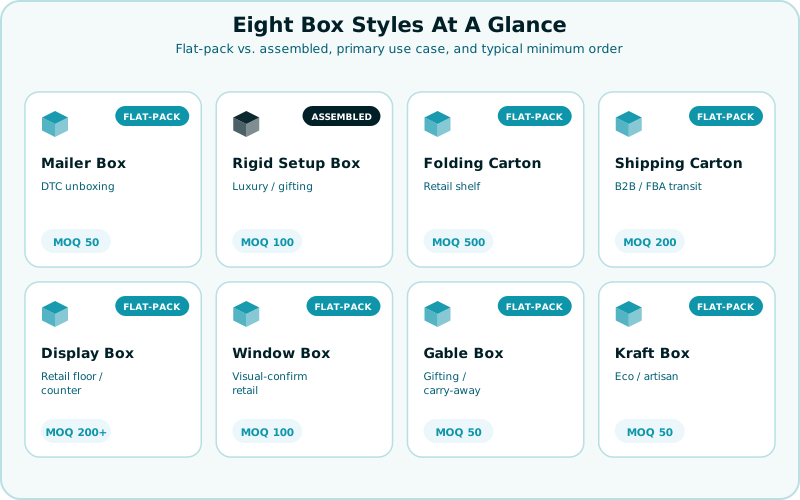
Comparing the Eight Formats at a Glance
| Format | Flat-Pack Ships | Primary Use Case | Typical MOQ Start | Key Trade-Off |
|---|---|---|---|---|
| Mailer Box | Yes | DTC unboxing | 50 units | Inside print adds cost |
| Rigid Setup Box | No | Luxury / gifting | 100 units | Higher unit cost, no flat-pack |
| Folding Carton | Yes | Retail shelf | 500 units | Thin stock needs right material grade |
| Shipping Carton | Yes | B2B / FBA transit | 200 units | Minimal brand presence |
| Display Box | Yes | Retail floor / counter | 200-500 units | Die-line engineering required |
| Window Box | Yes | Visual-confirm retail | 100 units | PET film adds a production step |
| Gable Box | Yes | Gifting / carry-away | 50 units | Handle limits weight capacity |
| Kraft Box | Yes | Eco / artisan | 50 units | Natural aesthetic, not for luxury |
For a deeper look at how materials affect performance across these formats, read the packaging materials comparison. If you are weighing rigid versus mailer for a specific product, the rigid box vs. mailer box guide covers the decision in detail.
A few more questions on picking a format
How much does each of these eight box styles cost at a 500-unit run? Cost at any given run size depends on material, print method, and finishing, not just the box style, so we do not publish a fixed number per format. As a rule of thumb, flat-pack corrugated styles (mailer, shipping carton, kraft) cost less per unit than assembled rigid boxes at the same run size, and offset printing at 500 units starts to beat digital on a per-unit basis. For real ranges, see how much custom packaging costs.
What clearance should I use when measuring for a display box or window box? Measure your product at its widest point and add roughly a quarter to half an inch of clearance so it seats cleanly without binding. For a window box, also note where you want the window to sit relative to the product's most photogenic angle. Our measuring guide covers this format by format.
Which of these styles is best for shipping fragile items like glass or ceramics? A rigid setup box with a die-cut foam or molded pulp insert protects glass and ceramics best on its own. For parcel shipping, pair it with an outer corrugated shipping carton for a second layer of protection. See our fragile product packaging guide for insert options by material.
Get Your Quote and a Free 3D Mockup
Once you know your format, confirm it fits your product dimensions and budget. Every quote includes a free 3D mockup so you can see your artwork on the actual box structure before committing to a production run. Responses come back within 48 business hours.
Request your quote at /get-quote. If you want to feel the stock and finish first, request a physical sample: the sample fee credits toward your first production order. We ship to all 50 US states.